


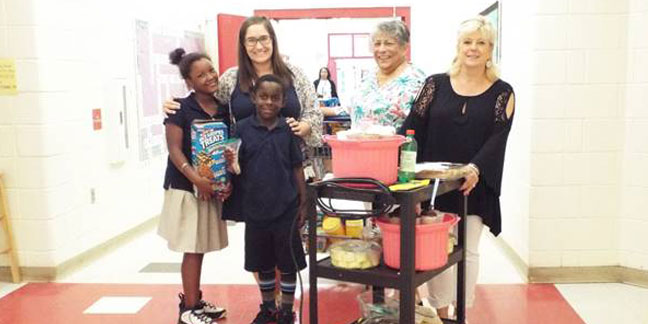
 CHARLOTTE — Kathy Capps and Phyllis Mennitt stroll through “Main Street” of Thomasboro Academy armed with a push wagon of hand-baked goods and a shopping cart of store-bought treats. Smiles gleam on their faces while they receive a celebrity greeting from their biggest fans, the children and teachers of Thomasboro Academy.
Hugs and kisses come from all directions while teachers surround “The Angels” in search of their favorite butter pecan cupcake or double-dipped chocolate cake slice. The teachers look at “The Angels” with a smile and a shake of their head as if the cupcakes are Tylenol, and the “We Care” Team are nurses providing relief.
“When I see them, I know someone let the sunshine through the doors. These ladies have been with us for as long as I can remember, ever since I’ve been here,” claims Academic Facilitator Lori Rondo.
Pictured: Phyllis Mennitt and Kathy Capps of St. Luke Church, pictured with teacher Meghan Bernhard, are among “The Angels” who visit Thomasboro Academy on a regular basis, brightening the day for students and teachers. (Lisa Geraci |Catholic News Herald)
Each Friday morning the “We Care” Team, comprised of Phyllis Mennitt, Ann Marie Luce, Olga Monroe, Marlene Perotta, Fatima Robaina and Kathy Capps, drives from Matthews to Thomasboro Academy to serve the kindergarten to eighth-grade classes. Each teacher receives a baked item, class snacks for each student, and classroom supplies. Even the cafeteria workers and custodians get a snack. Two of the eighth-graders help distribute the snacks with “The Angels.” Some volunteers, such as Luce, go into the classroom and help the students learn to read while the team continues to distribute the snacks. The whole process starts around 11 a.m. and takes about two-and-a-half hours.
“Sometimes we laugh all the way home, sometimes we cry,” Mennitt says.
Destiny, a seventh-grade student “The Angels” have known since kindergarten, dances her way down the hallway, jumping up to give Kathy a hug and a kiss on the cheek. “I love you!” she says, clinging to Capps’ neck. Destiny does not take a treat right away, but marvels at all the choices.
The affection that Capps and Mennitt display with the children is true and palpable – the reason they have pet names such as “Mom” and “St. Luke’s Angels.”
As the middle-school students walk down the hall in a single-file line, “The Angels” call out the name of a boy. No matter how “cool” he tries to appear, the second he looks up, he melts at the sight of Capps and Mennitt, as if it was the first time he saw them as a kindergartner. His eyes grow big, a smile peeps out, and he breaks the line for a hug.
The kindergartners are adorable and love “The Angels” and their cart, too, but the older students have gotten to know “The Angels” on a different level, spending holidays, having parities, eating dinners, opening presents, sharing conversations. For them, the St. Luke parishioners are more than great bakers who come over to pass out snacks every Friday. They represent stable figures of joy and love.
For the new teachers at Thomasboro Academy, “The Angels” are a weekly reminder of love, support and thanks.
“We do this so they can look forward to something. The teachers have so much pressure on them. There is minimal parent involvement. Everyone in the community wants to tell them what to do and how to do it, but does not really understand the reality of what is truly happening inside these walls,” Capps says.
“On top of all that, they have bills and their own problems. Many of the teachers are single and young; a lot of them actually call us “mom.” The teachers and I are in constant contact even when I am not there. We are texting and emailing, chatting about school.”
“Sometimes the teachers need more hugs than the students,” says teacher Tamika Truesdale. “Everyone has their own unique relationship with Kathy.”
“She is one of kind,” she adds after having a lengthy conversation about her son and husband. “Make sure you text me those pictures,” she reminds Capps before closing her door, rice crispy treat in hand.
“Thomasboro is not the typical school,” Capps says. Despite the smiling faces of the students, dressed in their nicely pressed uniforms, Thomasboro is located in an environment that demands constant love, support, guidance and patience.
Out of the 800 students at Thomasboro Academy, 99.6 percent are classified as economically disadvantaged, and about 20 percent either homeless or in a transitional housing situation. The school received an “F” for the 2016-2017 school year, a state rating solely on end-of-grade scores and standardized test proficiency.
But the level of commitment from the administrators, teachers, community and even the students themselves tells another story – a story of hope and of overcoming obstacles.
“Thomasboro is the best and the worst experience all at the same time,” Capps says. “Some people just can’t handle it. They try to eat lunch and work in the classroom, but it was just not a fit. You can’t be judgmental. You have to roll with the punches. Whatever the child needs from the social workers, to the teachers, to the administrators, to us, we are ready.”
“This all started about 14 years ago when my daughter was in first grade and went to elementary school at Elizabeth Lane. Elizabeth Lane just adopted ‘a sponsor school,’ Thomasboro. All we knew about it was that it was a high-need school,” Capps explains.
“I started there as a lunch buddy. I ate with a girl that was also in first grade just like my girl. That first girl did it. They were all desperately craving attention. They just wanted someone to listen to their stories and hug them. I just fell in love with the whole class.”
As her relationship with the class grew stronger, she started to realize, “These pint-sized kids had adult-sized problems. Instead of ‘I need a pencil,’ it would be more like, ‘I don’t know where I’m going to sleep tonight.’ Many of the students had behavioral issues. Some were never able to apologize, they had their guard up, they were angry. Deep down they were just kids that desired to soften up and open up.
“I knew I found my place and this is where I could make a difference,” she says.
“But this is more about St. Luke than me,” she continues. “Without St. Luke it would have stayed low-key, but St. Luke has made it possible for this movement to grow. I am so awed and inspired by the whole church. During the first visit to Thomasboro, I noticed it was cold and the kids had no coats and small shoes. Straight after, I went to St. Luke’s and asked Father Jim (Hawker) if they could possibly do a clothing drive. St. Luke started collecting clothes immediately. Fourteen years later, we are still collecting supplies, food, shoes and uniforms, in a wooden crate, in the back of the church, marked ‘Thomasboro’.”
During the fall months, Kathy started casually discussing Halloween plans with the kids. The kids got a laugh out of that. They were not going trick-or-treating because the area was too dangerous. Plus, they didn’t have anyone take them. They didn’t have enough money for costumes or candy.
“It made me think – Halloween was such a little thing that kids take for granted, but these kids were really missing out on their childhood, their memories,” Capps says.
St. Luke parishioners came to rescue, and the parish youth group started making treat bags to give to the kids for Halloween.
“Then we just started adding on for each holiday. For Thanksgiving we started making sure needy families had a turkey. During Christmas, we bought every single child attending Thomasboro a gift.
“We started small, but currently, the Knights of Columbus does the food for Christmas, the youth group does the Halloween treats, Faith Formation collects hats and gloves. ‘Young at Heart’ helps with something every month, and the Hispanic community helps with our ‘We Care’ budget.
“Every ministry at St. Luke has found a way to come through for these kids,” Capps says.
“This is an amazing story, I never saw coming and it would not have happened if it was not for the help of St. Luke,” she adds.
“This whole experience has been life-changing. I am still in contact with the very first girl I sat down with for lunch, as well as other students from that class who have gone to college or are working. It is unusual for a partnership to last this long.
“It started out as volunteering and now we are family, year ’round.”
Says one teacher as he grabs a slice of pumpkin swirl cake from the wagon being pushed by “The Angels,” “They are just the lift we need around here.”
— Lisa Geraci, correspondent