


 I lost my mother unexpectedly last November, after having lost my father after a long illness eight years earlier. My siblings and I suddenly found ourselves “orphans” as we marked our first Thanksgiving and Christmas without either parent. Now we are anticipating our first Mother’s Day without Mom.
The loss of a loved one, especially a parent, can engender intense and contradictory feelings. I have found that the Church’s 50-day celebration of Easter has offered me unexpected graces and consolations as my siblings and I mourn the loss of our mother.
Two Easter symbols have helped me to believe that in Christ crucified and risen all of our grief and pain – all our woundedness – can be healed. The first is the Paschal candle and the second is the Divine Mercy image. Despite participating in the Easter Vigil every year, I never really paid attention to the five grains of incense with which the Paschal candle is inscribed before being lit. These symbolize the wounds of Christ. As he presses the grains into the candle, the priest says, “By His holy and glorious wounds, may Christ the Lord guard and protect us.”
In “Remembering God’s Mercy,” author Dawn Eden observes, “it is only after these wounds are called to memory that the light of the risen Christ, symbolized by the ignited candle, shines forth and spreads its glow … The light of faith – the lumen fidei that shines upon us and gives us our identity as Christians – is the light of Christ precisely as wounded.”
In the Divine Mercy image revealed to St. Faustina, the risen Jesus reveals the wounds of His crucifixion and His pierced heart. In her diary, St. Faustina relates numerous occasions when Christ invited her to take refuge in His sacred wounds, as in a safe hiding place. Christ also refers to His wounds as a fountain of life and mercy, and Faustina sees in them a sign of God’s great love. It is consoling for me to realize that in His unfathomable mercy, Christ embraces both my mother and myself, with all our human imperfections, hiding us in His merciful wounds.
The Divine Mercy image and the Paschal candle remind me that it is in the Mass that we are bathed in the waters of new life, fed with His Living Bread and healed of our wounds. It is also in the Eucharist that we are united with the communion of believers, including those who have passed on before us. There I can still experience communion with my parents – though in a manner quite different from our regular visits and phone calls. As our Catholic faith teaches in the catechism, the union of those who sleep in the Lord with those who are left behind “is in no way interrupted … (but) reinforced by an exchange of spiritual goods.”
Those who have gone before us to their heavenly reward do not cease to intercede for us. “Being more closely united to Christ, those who dwell in heaven fix the whole Church more firmly in holiness,” the catechism says. By their concern, “our weakness is greatly helped.” In faith, I know that my bond with my parents is not broken by their passage from this life. My siblings and I are not really orphans after all. Happy Mother’s Day, Mom!
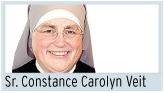
Sister Constance Veit is communications director for the Little Sisters of the Poor.