


America at 250
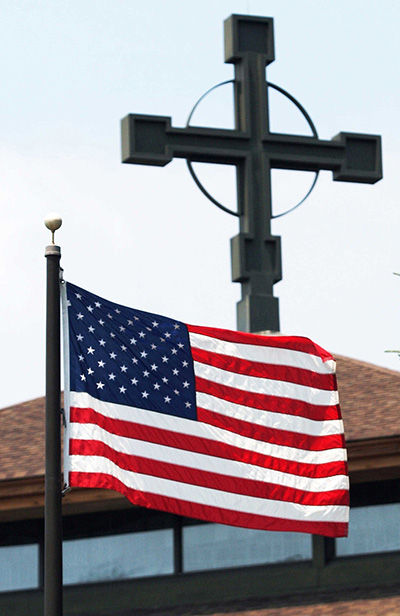 As the United States indulges in a star-spangled celebration of its 250th birthday, a cornerstone of historical significance that stands out is religious freedom, and unlike for many other nations, it is a unique founding principle of this nation.
“From the beginning, we’ve had this quarrel – that’s why I call it the Founders Quarrel – which is, on the one hand, there was agreement that we should have religious liberty. But what that actually meant was what?” Linda Przybyszewski, associate professor of history at the University of Notre Dame, told OSV News.
“They argued about it,” she said of the Founding Fathers, “because so many of them believed that some form of belief in God was necessary to teaching people virtue and morality – since we need virtue and morality in order to be a self-governing republic. The question then became, ‘Who’s going to teach the religion?’ ... And I don’t think that has ever gone away.”
A mix of faiths
The variety of religious traditions complicated matters.
“At the founding of the United States, we saw a fascinating mix of groups who argued for religious liberty,” explained Przybyszewski. “There were deists – people who believed in God, but had their doubts about Christ – like Thomas Jefferson and James Madison. There were also sort of ‘orthodox’ churches, which were in some cases newer – like the Baptists, or the Presbyterians – and they had been actively persecuted by colonies that had established churches; that is, churches with privileges.”
During the colonial period of the early 1700s, most colonists – about 85% of some 500,000 – lived in colonies with an official state church, typically the Congregational or Anglican Church.
“This disparate group of people argued very strongly for religious liberty,” Przybyszewski said, “which is why we have in the First Amendment to the U.S. Constitution that Congress shall make no law regarding the establishment of religion or imposing on the free exercise of religion.”
Michael Breidenbach – dean of the Honors College and associate professor of history at Ave Maria University in Ave Maria, Florida – agreed.
“Religious experience for colonial Americans was very varied. There were some colonists who came specifically because they were fleeing religious persecution,” he shared.
“There were others who were trying to find a better life than what they had in Europe. And most of them were, I would say, a Christian in some description – although there are notable and important exceptions with Jews and Muslims; and of course, those who did not profess the faith, gnostics or atheists,” said Breidenbach.
‘Free exercise’ – except for Catholics
The Maryland Toleration Act of 1649 – written by Cecil Calvert (1605-1675), son of George Calvert (1580-1632), the Catholic founder of the colony of Maryland (later home of the first U.S. diocese) – is typically identified as the first American law specifically referring to “the free exercise” of religion.
Ironically, it was repealed in 1654 when William Claiborne, who was stridently anti-Catholic, took control of the colonial government. A new law was passed barring Catholics from openly practicing their religion.
“By the time we get to American Independence,” said Breidenbach, “what changes is that we see a shift in the discourse to the natural rights of someone to freely exercise one’s religion – public worship – according to the dictates of their conscience. And that’s a different commitment because the government can’t abridge those rights,” he added.
Prejudice against Catholics
Catholics, Breidenbach noted, were at the forefront of the commitment for the natural rights of religious liberty.
Archbishop John Carroll of Baltimore (1735-1815) – the first Catholic bishop in the U.S. – wrote publicly on the subject; his brother Daniel Carroll (1730-1796) was a framer of the U.S. Constitution; and their second cousin Charles Carroll (1737-1832) was the only Catholic to sign the Declaration of Independence.
Still, non-Protestants often faced exclusion and outright persecution.
In the 17th century, Massachusetts hanged people for being Quakers; when the Declaration of Independence was signed, nine of the 13 colonies prohibited Catholics and Jews from holding office; in 1838, the governor of Missouri issued Executive Order 44, calling for the “extermination” of the Mormons; and during the 1830s, Protestant mobs burned convents and sacked churches during anti-Catholic riots.
“A lot of American Protestants didn’t even think the Catholic Church was producing people who were going to make good citizens,” explained Przybyszewski. “The Protestant view of Catholics was that this was a backward, superstitious, not really Christian church – which their faith had rejected centuries earlier.”
Stigma lingers
Since May 2020, at least 410 anti-Catholic episodes have occurred throughout the country, the U.S. Conference of Catholic Bishops notes.
“Incidents,” the USCCB states, “include arson, statues beheaded, limbs cut, smashed, and painted, gravestones defaced with swastikas and anti-Catholic language and American flags next to them burned, and other destruction and vandalism.”
While present questions of religious liberty may seem discouraging, Breidenbach sees a lesson in the nation’s revolutionary history.
“Catholics in colonial America were presumed dangerous until proven loyal. And to go from being suspected subjects of a king to trusted patriots in a new republic is a remarkable transformation,” he emphasized.
— Kimberley Heatherington