


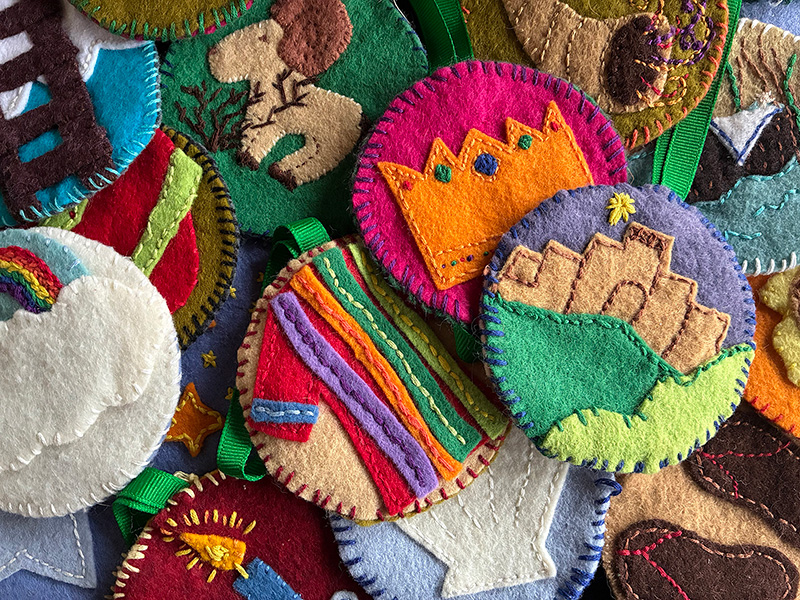
 Jesse trees are a simple but meaningful Advent practice. Families place ornaments symbolizing Jesus’ ancestors on a Christmas tree or separate tree while sharing their stories. The tradition allows children (and adults) to connect with the people and events that have shaped our faith.There are countless Advent traditions in the Catholic Church, but for me, the Jesse tree is one of the richest. The more years I have used the Jesse tree, the more I have come to love and appreciate the treasure that it is.
The Jesse tree is the family tree of Jesus. It traces the lineage of Christ all the way back to Adam and Eve. In other words, the Jesse tree connects the dots between the Old Testament and the New. It shows us that God has been planning since the fall of Adam and Eve to bring us back to Him through the incarnation of His Son, Jesus.
Rooted in the Middle Ages
The Jesse tree combines visual and storytelling elements like other family trees. Jesse trees first appeared in the Middle Ages, a time when most people were illiterate and the invention of the printing press had not yet made Bibles readily available to Catholics in the pews. Faith was largely passed on orally.
Through paintings, stained-glass windows and carvings, theologians and artists worked in tandem to teach the story of salvation history through the Jesse tree. The pictures of people and the symbols used with them helped tell the Bible stories by assigning illustrations to the words.
Named for King David’s father
The Jesse tree is named for the father of King David, a relatively obscure figure of the Old Testament who vaulted to prominence with the prophecy of Isaiah, which states that “Then a shoot will spring from the stem of Jesse, And a branch from his roots will bear fruit” (Isaiah 11:1).
The verse refers to the coming of the Messiah from the family of King David. Other than this oblique reference to him, what we know about Jesse the historical figure comes largely from the Jewish tradition, which says he was a well-respected man whose great faith was recognized during his lifetime.
Over time it became tradition to review the family of Christ each Advent as a way of showing God’s intentionality in preparing for the Incarnation and helping us prepare our hearts for of Christmas.
Tracing salvation history
The modern Jesse tree is designed to be used at home during December. Each day a story is told from salvation history, and an ornament (containing the symbol for that person or event) is hung on either the Christmas tree or a separate “Jesse tree.”
Jesse trees today contain many of the same elements of the historical Jesse trees. There is a combination of the visual (ornaments and illustrations in books) and oral storytelling. Jesse tree books and ornament sets have made home use possible and easy for families.
Some Jesse tree books focus less on the lineage and more on the prophecies that announced Christ’s coming to the Israelites. Some Jesse trees focus on events – the fall of man, the flood of
Noah and the tower of Babel. Others focus on the people of the lineage of Matthew.
Old stories with new eyes
For us adults, the Jesse tree offers an opportunity to return to what might be well-worn stories with new eyes.
The men and women included in Jesus’ family tree aren’t always who we’d expect, not even those we think we know well. Some of the figures are giants of the Old Testament. Others are more easily overlooked. In meditating on and learning about these figures together, the Jesse tree offers family members an opportunity to become more comfortable in sharing their personal faith and prayer lives with their loved ones.
Which brings me to my final reason for loving the Jesse tree – it’s easy. I’m not ashamed to admit that I love the Jesse tree tradition because it is realistic for my busy family to accomplish. I don’t mean to imply that the tradition is light or fluffy. There’s plenty of depth in short meditations. But it is an activity that doesn’t require a lot of planning and preparation.
Making the Jesse tree the tradition of our family ensures that we prepare our hearts to receive the Savior.
— Colleen Pressprich is the author of “The Jesse Tree for Families” and “Marian Consecration for Families with Young Children.” She writes from Michigan.