


 As a kid, the Fourth of July was the only time I ever got to see fireworks. I thought that the reason fireworks existed was to replicate what we sing about in “The Star-Spangled Banner” – “the rockets’ red glare” and “the bombs bursting in air.”
What’s interesting is that fireworks have an ancient history, and they weren’t created to be bombs bursting in air. It was quite the opposite; it was more celebratory. They were created for something entirely different than what they ultimately were used for.
In our celebration of the 250th anniversary of the birth of our nation, we should ask ourselves the same question. Our country was born for a particular reason, but is that still valid today? Are we using our freedom for the purpose for which it was given to us, for which it was fought for, for which many people offered their lives?
Our readings this weekend share with us a deeper understanding of the freedom that we enjoy in this country and that we hope our nation expresses to the rest of the world.
But it’s incumbent upon all of us to ask ourselves: Have we fully understood the deeper reality of the freedom we’ve been given?
In our first reading from the second book of Kings (2 Kings 4:8-11, 14-16a), we hear this wonderful story about Elisha, who is on the road and is oftentimes welcomed into a couple’s home. While the couple is described as being well off, the one thing that this particular couple does not have is the one thing they desire the most – and that’s a child. Amidst all of their concerns, there’s no question about whether or not they should be welcoming a stranger into their home.
My brothers and sisters, we have been freed for the purpose of welcoming the stranger. Hospitality should be a hallmark of what we are free to do. Like that couple, all of us are lacking something. Yet amidst our lacking, we should be looking for ways to be hospitable, especially to strangers. We have a debate going on in our country about welcoming the immigrant. Let’s be clear in realizing that we have been given this freedom for the purpose of sharing that freedom with others.
Freed for a purpose
St. Paul, in his Letter to the Romans (Romans 6:3-4, 8-11), talks about how we have been freed for the purpose of living like Christ. He says those of us who have died with Christ will rise also with Christ. We are baptized into His death – not in some future moment, but to live it right now. We’ve been given freedom for that purpose, to live our faith.
Religious liberty should not be something that we take for granted. It should be something that we cherish. Because we cherish it, our worship, our engagement in faith, should not be something that we do once in a while when it’s convenient. We have been given freedom for the purpose of worshiping our God, of sharing our faith with one another, of being a witness of the resurrected Christ in this world, in this land of ours.
Religious liberty should not be taken for granted. It should be something that by our daily witness we show to the rest of our brothers and sisters.
In our gospel today (Matthew 10:37-42), Jesus gives us a challenging message about taking up our cross. We see the heart of that sacrifice being lived out by our ancestors – who gave their lives, who picked up the cross for freedom. We should ask ourselves: how are we going to do that today?
We have been given freedom to sacrifice for the common good. Too often in our American lives, we have a sense of rugged individualism. I do this for me. I’ve been given my rights and my freedoms for me. That is not at the heart of what the Founders had in mind, and it is certainly not at the heart of the Gospel message.
What we are called to do today is to pick up our cross for the sake of others. We as Catholics should be going out to try and help others carry their cross for the common good – to walk with others who are struggling.
As we celebrate our own 250 years of freedom – not from tyranny as our founders did, that’s a story of our past – but freedom in this time, in this year, in this space, in this country, to make a difference.
We live in a time of tremendous division. We as Catholics are called to give witness to the unity of the Trinity, called to give witness to our unity in the Body of Christ. We should be carrying the torch of unity that shows the world we will not give in to the division that is enmeshed in the fabric of every conversation in which we find ourselves.
We have been given freedom for unity. May we put aside the divisions that we see and realize that when we passionately take up the cause of freedom for the unity of the United States of America and for all the world, we witness the greater purpose of God’s loving gift of freedom – of freedom for unity, of freedom for communion, of freedom for life in Christ, that welcomes the stranger, that appreciates the real gift that religious liberty is, and that picks up not only my cross but the crosses of others, for the common good.
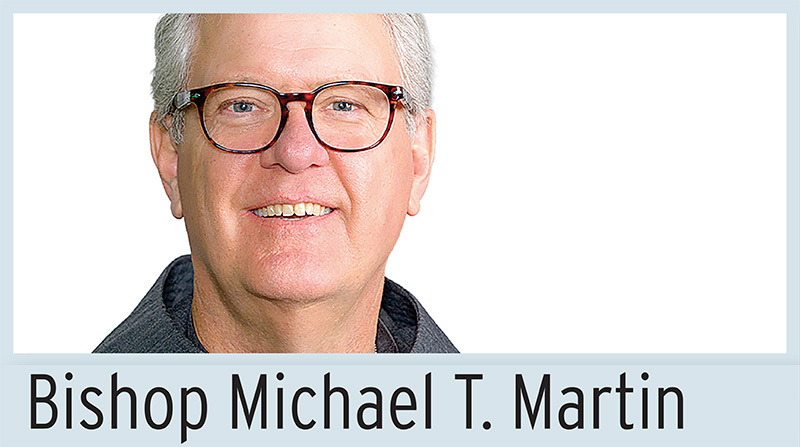
Bishop Michael T. Martin, OFM Conv., leads the Diocese of Charlotte. This commentary is excerpted from a homily he is sharing with all the people of the diocese this weekend, June 27-28, in advance of the 250th anniversary of the nation’s founding.