


 Dorothy Day thought that the parable of the workers from Matthew’s Gospel (Mt 20:1-16a) justified a Catholic’s support for the idea of a living wage. She wrote, “He spoke of the living wage, not equal pay for equal work, in the parable of those who came at the first and the eleventh hour.”
Now aside from this specific suggestive interpretation, her general point was that, by our accounting, God is often inexplicably gracious, and further that God’s graciousness should make us gracious too – in all things, even in matters economic.
At the end of the parable Jesus says, “the last will be first, and the first will be last” (Mt 20:16). He is not talking about wages here but about Israel, the covenants, the kingdom of God, and who is welcome.
The kingdom will surprise us
Jesus is saying that when it is all said and done, we are going to be surprised by who we see in the kingdom. Because it won’t just be those who are conventionally good or conventionally religious or righteous; the kingdom will also include sinners and tax collectors, those with faith and the penitent, whomever they are. Even if they played the game wrong all their lives, or didn’t play at all, still it’s possible that they just might win in the end. For such is God’s generosity.
And not just included, such people might even find themselves “first” in the kingdom of heaven. It’s best not to be too clear what being first may precisely mean; St. Paul wrote that “star differs from star” in glory, and it’s probably better to leave it at that (1 Cor 15:41). Nonetheless, we will likely be very surprised by who is in heaven and how it’s all arranged.
If the “In Paradisum” is anything to go by, heaven has a homeless man working the door – that’s the point: in heaven as it isn’t on earth. It’s exactly what the self-righteous Mrs. Turpin learned at the end of
Flannery O’Connor’s short story “Revelation.” In a vision she saw the heavenly procession. At the front of it was a “vast horde of souls … battalions of freaks,” people whom she had always looked down on and judged.
And only at the end of the line did she see “a tribe of people whom she recognized at once as those who, like herself … always had a little of everything.” These latter saints at the back of line, all their lives, were used to being first – but again, in heaven as it isn’t on earth. That’s why O’Connor ends the story telling us about their “shocked and altered faces” and how all their superficial virtues had to be “burned away.”
They had to learn just how differently God saw things.
Can we see as God sees?
That is the spiritual and moral challenge of the parable. How differently does God see things? How differently does He see others? And if He sees others differently – say, if He loves them – then why do we hold on to our prejudices and petty hatreds? Wouldn’t it be sensible, spiritually and morally speaking, to change how we see things and see other people? Wouldn’t it be sensible to try to see the way God sees?
For that is what would truly make us gracious. And here we come back to what Dorothy Day was saying about this parable and a living wage. What she was suggesting is that sometimes one’s spiritual sense should override one’s economic sense, that sometimes – often, in fact – one should not just be fair but gracious. For that’s exactly how God is; that’s exactly what He does. “Graciousness is an old-fashioned word, but it has a beautiful religious tradition,” Day once wrote. It’s to participate in divine life.
So, this parable invites us to look at everything differently. It invites us to see everything from God’s perspective, to see everything in terms of grace and graciousness. Which is, admittedly, to see things strangely.
But it’s also to see a better world and maybe the beginning of heaven, too.
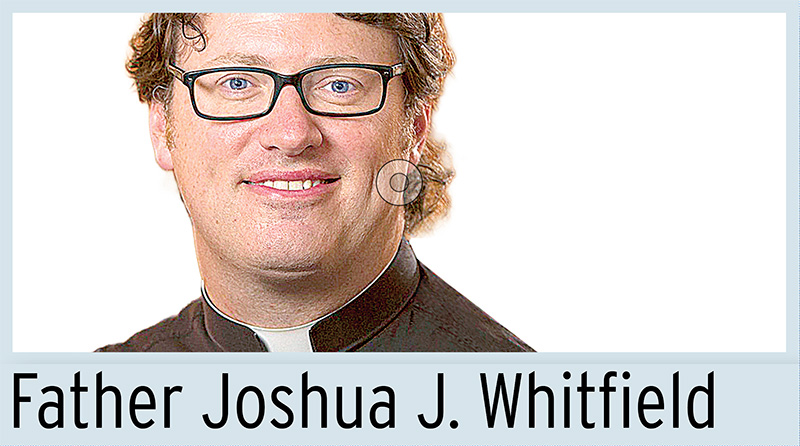
Father Joshua J. Whitfield is pastor of St. Rita Catholic Community in Dallas and author of “The Crisis of Bad Preaching” (Ave Maria Press) and other books.