


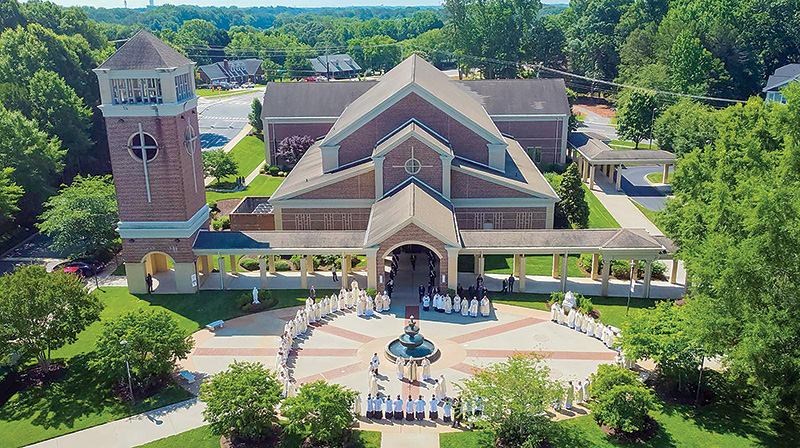
 The diocese is exploring a potential philanthropic initiative to address critical needs at parishes, schools and ministries across western North Carolina and is slowing plans for a cathedral. Due to its larger seating capacity than St. Patrick Cathedral, St. Mark Church in Huntersville will continue to be used for major diocesan liturgies, including the deacon and priest ordination Masses (shown above) and the Chrism Mass. (Aidan Creter | Catholic News Herald) CHARLOTTE — The Diocese of Charlotte is exploring a potential philanthropic initiative of up to $150 million to address critical needs at parishes, schools and ministries across western North Carolina – and is slowing plans for a new cathedral.
Bishop Michael Martin and diocesan officials say a new “mother church” is still needed to replace St. Patrick Cathedral in Charlotte, one of the smallest in the country and unable to host large diocesan liturgies. However, they say other pressing needs in the rapidly growing diocese – now home to approximately 560,000 Catholics – have emerged as higher priorities.
Diocesan leaders continue to study growth trends and potential sites for a future cathedral, but for now St. Patrick will remain the cathedral and St. Mark Church in Huntersville will continue being used for major diocesan liturgies, including ordinations and the Chrism Mass.
In Spring 2024, the diocese began early planning for a new cathedral based on recommendations from a task force of clergy and lay leaders. Although no site or cost had been determined, the task force advised that preparation and fundraising begin soon so construction could start by 2030.
Now, instead of launching a cathedral campaign, the diocese is considering a broader effort to invest in five key areas: parishes, Catholic schools, land acquisition for future growth, Catholic Charities and under-resourced ministries. (See list below.)
“Our planning and research are helping us crystallize what we need to do now to meet the demands of growth and deliver on our mission of spreading the Gospel,” Bishop Martin told the Catholic News Herald.
The diocese’s Development Office is surveying more than 7,000 previous donors for feedback on the proposed investment plan.
“We want to open up the conversation to donors and other supporters to help set priorities and ensure a successful initiative,” said Jim Kelley, diocesan development director.
Although a target goal is not yet finalized, the philanthropic effort will likely be the largest since the diocese’s 2013 “Forward in Faith, Hope, and Love” campaign, which raised $65 million for projects that have made lasting improvements.
Broader needs revealed
Reflecting trends across the South and West, the Catholic population in the diocese has grown more than 50% over the past decade.
Plans for a major fundraising initiative have been in discussion for several years, as parishes and ministries have identified needs across the diocese – including the possibility of a new cathedral.
But a long-range parish planning process launched in 2023 – along with unprecedented devastation of Tropical Storm Helene last fall – have helped bring into sharper focus widespread challenges facing the diocese’s 93 parishes, 20 schools and more than 50 ministries, diocesan officials said.
In addition, parishes have lined up to submit construction plans of their own before a 2025 moratorium on parish fundraising to clear the way for parishes and the diocese to unite their philanthropic efforts toward the cathedral project.
Over the past two years, parishes, schools and other diocesan entities requested approval for nearly 50 major projects involving capital campaigns, ranging from new church buildings, to fellowship halls, to renovations and repairs. Those physical improvements do not include additional needs also identified by parishes and ministries, such as enhancements to evangelization and outreach efforts.
“Based on our growing Catholic population, we were well aware that many of our parishes needed to grow physically, in terms of space and facilities, as well as programmatically in pastoral outreach,” said Emmett Sapp, diocesan director of construction and real estate.
“But our new planning process and the moratorium prompted parishes to think more intentionally about planning for their future,” he said, “and that exposed significantly more improvements they need to keep up with growth.”
Cathedral plans adjusted
As the new needs emerged, Bishop Martin was appointed to succeed retiring Bishop Peter Jugis in April 2024, and immediately began evaluating the cathedral project and overall needs across the diocese.
“While every diocese needs a mother church where people can come together with their bishop in communion with Jesus,” he said last August, “I want to look at all of our needs as a faith community and allow for plenty of input from clergy and parishioners as we consider a project of such magnitude.”
Although no cost had been determined, estimates to buy land and build a cathedral ranged up to $100 million, so Bishop Martin and the diocese’s Presbyteral Council and College of Consultors, explored alternatives – asking the diocese’s largest parishes to consider becoming the cathedral if construction of a new one was delayed.
With capacity for 1,500 people, St. Mark Church in Huntersville was identified as a suitable option, particularly because of its longtime role hosting ordinations. But its location outside Charlotte – the diocese’s “see” city – meant Vatican approval would be required to move the cathedral seat.
After correspondence with Rome earlier this year, Bishop Martin met in April with then-Cardinal Robert Prevost (now Pope Leo XIV), who affirmed the bishop’s approach of focusing fundraising on widespread diocesan needs while continuing to plan for a future new cathedral.
“He also indicated that our proposal to designate St. Mark’s as the cathedral would present issues since it isn’t located within the city limits of Charlotte – and would likely mean changing the name of the diocese to Charlotte-Huntersville,” Bishop Martin said. “Such a change seemed cumbersome and confusing.”
A new cathedral remains a signature project in the diocese’s ongoing strategic planning efforts. Officials are regularly analyzing population trends and possible sites where new parishes could be established to accommodate growth. One solution may be to evaluate whether such a new parish site could also serve as the home of a new cathedral.
— Liz Chandler
Diocese of Charlotte Proposed Philanthropic Initiative
Outreach to People in Need
- Expand and endow Catholic Charities
- Provide support for under-resourced parishes and ministries for long-term growth
Strengthen Faith Our Communities
- Fund and endow local parishes’ needs
- Expand and endow Campus Ministry
- Ensure land purchases for future places of worship
Secure Our Future
- Provide access to and affordability of a Catholic school education
- Deepen investment in the formation of inspired lay leaders
- Further endow seminary and deacon formation
- Renovate and endow the Catholic Conference Center in Hickory