

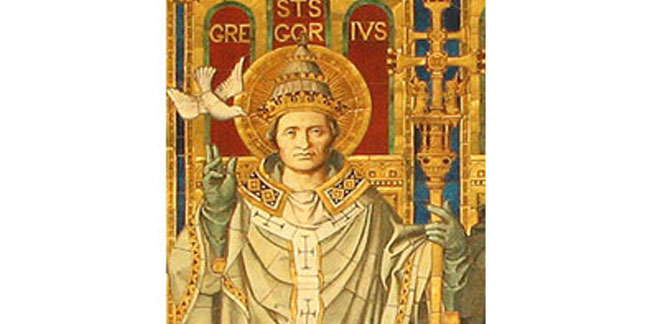
 St. Gregory the Great, a central figure of the medieval western Church and one of the most admired popes in history, is commemorated in the Ordinary Form of the Roman Catholic liturgy on Sept. 3.
Born near the middle of the 6th century into a noble Roman family, Gregory received a classical education in liberal arts and the law. He also had strong religious formation from his devout family, particularly from his mother Silvia, also a canonized saint. By around the age of 30, Gregory had advanced to high political office in Rome, during what was nevertheless a period of marked decline for the city.
Some time after becoming the prefect of the former imperial capital, Gregory chose to leave the civil administration to become a monk during the rise of the Benedictine order. In reality, however, the new monk's great career in public life was yet to come.
After three years of strict monastic life, he was called personally by the pope to assume the office of a deacon in Rome. From Rome, he was dispatched to Constantinople to seek aid from the emperor for Rome's civic troubles and to aid in resolving the Eastern Church's theological controversies. He returned to Rome in 586 after six years of service as the papal representative to the eastern Church and empire.
Rome faced a series of disasters caused by flooding in 589, followed by the death of Pope Pelagius II the next year. Gregory, then serving as abbot in a monastery, reluctantly accepted his election to replace him as the Bishop of Rome.
Despite this initial reluctance, however, Pope Gregory began working tirelessly to reform and solidify the Roman liturgy, the disciplines of the Church, the military and economic security of Rome, and the Church's spreading influence in western Europe.
As pope, Gregory brought his political experience at Rome and Constantinople to bear in the task of preventing the Catholic Church from becoming subservient to any of the various groups struggling for control of the former imperial capital. As the former abbot of a monastery, he strongly supported the Benedictine movement as a bedrock of the western Church. He sent missionaries to England and is given much of the credit for the nation's conversion.
He is known above all for his magnificent contributions to the Liturgy of the Mass and Office. He is one of the four great Doctors of the Latin Church.
In undertaking these works, Pope Gregory saw himself as the "servant of the servants of God." He was the first of the Bishops of Rome to popularize the now-traditional papal title, which referred to Christ's command that those in the highest position of leadership should be "the last of all and the servant of all."
Even as he undertook to consolidate papal power and shore up the West during the crumbling of the Roman empire, St. Gregory the Great maintained a humble sense of his mission as a servant and pastor of souls from the time of his election until his death on March 12, 604. He is the patron of teachers.
— Catholic News Agency
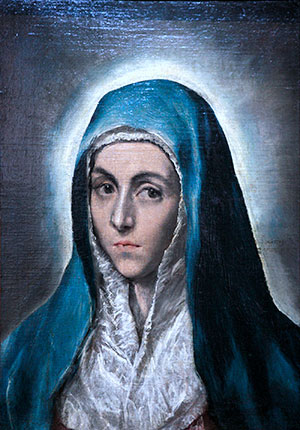 The feast of Our Lady of Sorrows on Sept. 15 commemorates the seven great sorrows which Mary lived in relation to Her Son, as they are recorded in the Gospels or through Tradition. On this feast day, we are invited to reflect on Mary’s deep suffering:
1. At the prophecy of Simeon: “You yourself shall be pierced with a sword – so that the thoughts of many hearts may be laid bare.” (Luke 2:35).
2. At the flight into Egypt; “Get up, take the child and His mother, and flee to Egypt.” (Mt 2:13).
3. Having lost the Holy Child at Jerusalem; “You see that your father and I have been searching for you in sorrow.” (Luke 2:48).
4. Meeting Jesus on His way to Calvary;
5. Standing at the foot of the Cross; “Near the cross of Jesus there stood His mother.” (John 19:25).
6. Jesus being taken from the Cross;
7. At the burial of Christ.
Prior to the Second Vatican Council, there were two feasts devoted to the sorrows of Mary. The first feast was instituted in Cologne in 1413 as an expiation for the sins of the iconoclast Hussites.
The second is attributed to the Servite order whose principal devotion are the Seven Sorrows. It was instituted in 1668, though the devotion had been in existence since 1239 – five years after the founding of the order.
— Catholic News Agency
Our Lady of the Sorrows is celebrated Sept. 15
The feast of Our Lady of Sorrows commemorates the profound union of heart that existed between Mary and her Son Jesus. As the mother of the Savior, she experienced many sorrows as a consequence of His mission – particularly during His Passion and death.
From the early days of Jesus’ life, Mary suffered maternal anxieties. She was warned about the pain to come when she and St. Joseph took Jesus to be presented in the
Temple in Jerusalem, according to Jewish law. There, they met an old man named Simeon, who told Mary that during her life she would feel the agony of seven swords piercing her soul.
Soon after, the Holy Family was forced to flee to Egypt to save Jesus from the murderous King Herod. Mary and St. Joseph also suffered the pain of fearing for Jesus when He went missing for three days and they later found Him in the Temple in Jerusalem. When her Son embarked on His mission, the opposition of so many people to Him must also have been a tremendous sorrow for her. All of this culminated at the Cross, where she saw him tortured, crucified and killed in front of a mocking crowd.
The title “Our Lady of Sorrows” therefore, honors the trials that the Mother of the “Suffering Servant,” as described in Isaiah 52:13-53:12, faced. Because of its link to Jesus’
Passion and death, this feast is the day after the Exaltation of the Holy Cross on Sept. 14.
Why do we celebrate a feast about Sorrow?
Like all feast days, this feast gives thanks to God for the saving work He has accomplished. In this case, we give thanks to God for His greatest creation, Mary, whose “yes” to becoming the mother of Jesus enabled our salvation.
The day also reminds us that Mary’s maternal love is here for us today – as intercessor, model of Christian discipleship, and as Mother of the Church.
St. Louis de Montfort once wrote, “If you put all the love of all the mothers into one heart, it still would not equal the love of the heart of Mary for her children.” This means that she suffers for us as well, and we can turn to her as we would turn to our biological mothers, in both joy and sorrow.
What was the prophecy of Simeon?
God has provided His people with many prophets, including an old man named Simeon, whose prophecy about Mary is recounted in detail in Luke’s Gospel:
“Now there was a man in Jerusalem, whose name was Simeon, and this man was righteous and devout, looking for the consolation of Israel, and the Holy Spirit was upon him. And it had been revealed to him by the Holy Spirit that he should not see death before he had seen the Lord’s Christ. And inspired by the Spirit he came into the temple; and when the parents brought in the child Jesus, to do for him according to the custom of the law, he took him up in his arms and blessed God and said, ‘Lord, now lettest thou thy servant depart in peace, according to thy word; for mine eyes have seen thy salvation which thou hast prepared in the presence of all peoples, a light for revelation to the Gentiles, and for glory to thy people Israel.’
And his father and his mother marveled at what was said about him; and Simeon blessed them and said to Mary his mother, ‘Behold, this child is set for the fall and rising of many in Israel, and for a sign that is spoken against (and a sword will pierce through your own soul also), that thoughts out of many hearts may be revealed.’ ” (Lk 2:25-35)
What are the swords that pierced Mary’s heart?
- The prophecy of Simeon (Luke 2:25-35)
- The flight into Egypt (Matthew 2:13-15)
- Loss of the Child Jesus for three days (Luke 2:41-50)
- Mary meets Jesus on His way to Calvary (Luke 23:27-31; John 19:17)
- Crucifixion and Death of Jesus (John 19:25-30)
- The body of Jesus taken from the Cross (Psalm 130; Luke 23:50-54; John 19:31-37)
- The burial of Jesus (Isaiah 53:8; Luke 23:50-56; John 19:38-42; Mark 15:40-47)
What is the Chaplet of the Seven Sorrows of Mary?
Also known as the “Rosary of the Seven Sorrows” or the “Servite Rosary,” this chaplet includes seven sets of seven beads, as well as seven medals that depict the Sorrows of Mary.
In 1239, the newly formed Order of the Servants of the Blessed Virgin Mary decided to devote their order to the Sorrows of Mary, meditating especially on her seven sorrows.
The Servites particularly promoted this chaplet during the Black Death in the 14th century.
During the Rwandan genocide of the 1980s, Our Lady of Kibeho, in an apparition recognized by the Church, greatly recommended the Chaplet of the Seven Sorrows during her appearances to three teenage girls. This practice could be a model for ourselves in times of trial.
— EWTN.com