


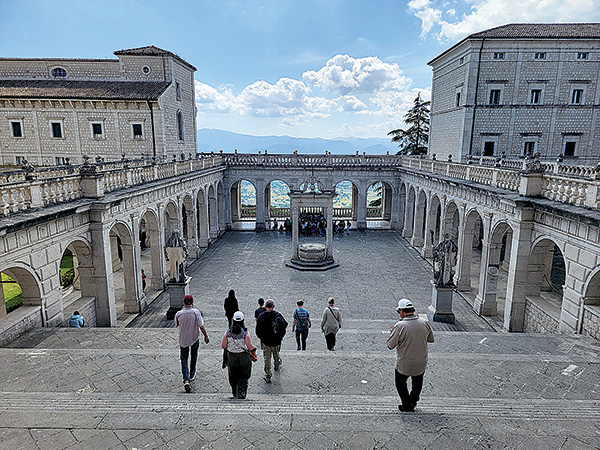
 Members of a local pilgrimage group walk the steps of the monastery at Monte Cassino in Rome.(Photos provided by Deacon Matthew Newsome)
 ROME — Throughout the Easter season, the Lectionary provides readings from the Acts of the Apostles. This book is in many ways a continuation of the Gospels, most especially the Gospel of Luke, with whom it shares an author. It tells of the continuation of the ministry and presence of Jesus in time, from the Ascension until about the year 62 or 63 AD.
Before His ascension, Jesus tells the apostles, “You shall be my witnesses in Jerusalem and in all Judea and Samaria and to the end of the earth” (Acts 1:8). The book of Acts tells the story of those whom Jesus sent to be His witnesses, focusing especially on Sts. Peter and Paul. But it only tells the first part of the story, which continues to this day.
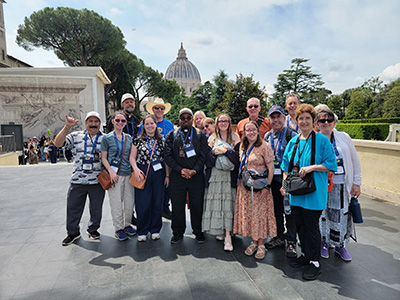
I was blessed this year to be able to lead a Jubilee Year pilgrimage to Rome during the Easter season to visit the tombs of these preeminent apostles. We, like countless others who have made that journey, were overwhelmed by the beauty of the churches that house their relics, the papal basilicas of St. Peter and St. Paul Outside the Walls, built over their respective tombs, as well as the Basilica of St. John Lateran, where the skulls of Peter and Paul are housed. The art and architecture exhibited in those sacred places are truly world marvels. The reason for all that beauty, the reason why those basilicas were built at all, is because the tombs of the apostles are there.
Why we travel
This gets to the heart of why we travel on pilgrimage, following in the footsteps of so many others who have made the journey to Rome over the centuries. We did not travel primarily to see beautiful works of art. We made the journey to venerate the relics of the apostles, those first witnesses of the Resurrection of Christ – and not only them. While on our pilgrimage, we were also able to venerate the relics of other great saints, each of whom played his or her own part in carrying forward the faith of Christ. We got up close and personal with towering figures such as St. Catherine of Siena, St. Robert Bellarmine, St. Francis, St. Clare, St. Benedict and St. Scholastica. We drew near to countless early martyrs buried in the catacombs. And we venerated the mortal remains of more modern saints such as John Paul II, Padre Pio and Blessed Carlo Acutis. Like St. Peter and St. Paul, these men – and women, too – gave witness to Christ by their holiness of life and thus carried on the great apostolic mission.
Traveling great distances to see dry bones may seem like an odd use of one’s time and resources. But venerating the relics of the saints has been the motivation for pilgrimages for many centuries. Why are relics so important to our faith, enough for us to travel across oceans to be near them? God is everywhere, after all. We can pray at home just as well as in Rome. Christ is just as present in the Eucharist celebrated at your parish as He is in the Vatican. Why travel thousands of miles to see these sacred spaces?
I would argue that relics are important for the same reason that artists glorify God by their beautiful works and the same reason we celebrate the sacraments with bread and wine, water and oil. Our faith teaches us that God’s creation is fundamentally good – so good that He judged it worth redeeming when it fell. And God’s creation is physical as well as spiritual. So physical things can be used to mediate God’s grace to us, as they do in the sacraments. Physical things can be used to recall our minds and hearts to God, as sacred art and beautiful churches help us to do. Being physically in the places where God’s grace has been made manifest in the world through the actions of Jesus Christ and His saints helps us to connect to salvation history and to contemplate our part in it.

Sharing in the Resurrection
The saints are those people who most fully participate in the work of God’s redemption. While part of their person (their soul) is in heaven, another part of their person (their body) remains on earth. We might think that their soul in heaven is the “real person” while their body on earth is a mere empty shell, but we must resist that Manichean heresy.
That is Gnosticism, not Christianity.
We believe that human beings are body and spirit, “at once corporeal and spiritual” (CCC 362). As the Catechism puts it, “Spirit and matter, in man, are not two natures united, but rather their union forms a single nature” (CCC 365). So if a person is holy, their body is also holy, because the body is an essential part of a human person. Bodies exist in space. That means we can draw near to them, as we do on pilgrimages, to be in the presence of these holy people and ask for their intercession.
Our veneration of relics also points to our hope in the Resurrection. Because the saints share in Christ’s work of redemption, we have faith that they will also share in His Resurrection. Their mortal remains will rise with Christ on the Last Day, which is the hope of every Christian.
The theme of this Jubilee year is “Pilgrims of Hope.” Whether or not someone is able to make a literal pilgrimage to Rome or some other holy place for the Jubilee, the Church views herself as a “pilgrim people.” We are all travelers in this life toward our final destination. My prayer for all those who undertake a pilgrimage this Jubilee year is that their journey of devotion helps to sustain them along their greater pilgrimage to heaven, where we will glory with Christ and the saints forever.
Deacon Matthew Newsome, Catholic campus minister at Western Carolina University and regional faith formation coordinator for the Smoky Mountain Vicariate, is the author of “The Devout Life: A Modern Guide to Practical Holiness with St. Francis de Sales,” available from Sophia Institute Press.
— Deacon Matthew Newsome, Special to the Catholic News Herald