


CHARLOTTE — Bishop Michael Martin has joined a number of bishops across the United States in urging Catholics associated with the Society of St. Pius X to return to full communion after the Vatican’s declaration that the traditionalist group has broken away from the Catholic Church.
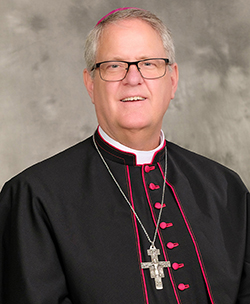 In a special pastoral letter issued July 17, Bishop Martin personally invited local followers of the SSPX to return to the Church and cautioned Catholics in the Diocese of Charlotte not to participate in liturgies of the now-schismatic society.
“I write as your bishop and spiritual father,” he said. “I recognize the sincerity of many who have been drawn to the Society over the years. Your desire for holiness, fidelity, prayer, and devotion is not in question.”
“At the same time,” he continued, “authentic Catholic faith is never separated from communion with Peter and the bishops united with him. The unity of the Church is not merely an administrative arrangement; it is a gift of Christ Himself.”
“Dear brothers and sisters,” he told SSPX followers, “the door of the Church is open. The heart of Christ is open. As your bishop, I welcome every effort toward reconciliation and assure you of my prayers, my affection and my pastoral support.”
If you have been attending a chapel of the Society of Saint Pius X and are now uncertain about your place in the Church, know that you are loved. The Church is your home. We desire to walk with you, answer your questions honestly, and help you experience the peace that comes from full communion with the Catholic Church. The door is open, and you are welcome.
— Bishop Michael Martin, OFM Conv.
READ THE FULL LETTER AND FAQS: Letter to the Faithful Associated with the Society of Saint Pius X
Vatican declares SSPX in schism
Bishop Martin’s message echoed statements issued by other bishops and the Vatican after the Society of St. Pius X’s July 1 consecration of four bishops without papal approval in Ecône, Switzerland.
Just days earlier, Pope Leo XIV had issued an unusual personal appeal to the society’s leaders, warning them that going ahead with the consecrations would constitute a schismatic act and could deprive the faithful of valid access to the sacraments.
“I pray for you, because to tear the seamless garment of Christ is a sin of extreme gravity,” the pope said. “I plead with you and ask you with all my heart: please turn back!”
After the consecrations, the Vatican’s Dicastery for the Doctrine of the Faith declared the society’s bishops had incurred automatic excommunication and clergy belonging to the SSPX “are in schism and therefore must be considered schismatics.”
Accompanying the Vatican’s July 2 decree was a note explaining that sacraments requiring the Church’s jurisdiction – including confession and marriage – are now invalid when celebrated by SSPX clergy.
SSPX leaders ignored the pope’s personal plea, dismissed the excommunication decree, and have filed an appeal with the Dicastery for the Doctrine of the Faith.
A movement at odds with Vatican II
Founded in 1970 by French Archbishop Marcel Lefebvre, the SSPX emerged in opposition to the Second Vatican Council. Although the society is best known for celebrating the Traditional Latin Mass, it rejects key teachings and reforms associated with Vatican II, including those concerning religious liberty, ecumenism, changes to the liturgy and liturgical calendar, broader participation by the laity, and the Church’s relationship with the contemporary world.
The current conflict dates back to 1988, when Archbishop Lefebvre consecrated four bishops without the approval of then-Pope John Paul II. Decades of talks failed to resolve the society’s objections to the authority of the Church and the legitimacy of Vatican II.
The society operates three chapels in North Carolina: one west of Charlotte in Mount Holly, and two near Raleigh. They are not in communion with the Catholic Church and are not under the jurisdiction of the Charlotte or Raleigh dioceses.
Bishop Martin cautioned local Catholics that participating in liturgies at SSPX chapels “could be construed as a schismatic act and should therefore be avoided.”
At the same time, he emphasized the Church’s desire for reconciliation.
“I invite all who have been attending Society chapels to prayerfully examine their relationship with the Catholic Church and to consider returning fully and visibly to communion with the Successor of Peter and the Church throughout the world,” he said.
“To those who may be fearful, uncertain, or wounded by these events, I say: do not be afraid. The Church desires not punishment but reconciliation; not exclusion but communion.”
A path back to communion
The Vatican has released instructions outlining a path for SSPX adherents to return to the Church and has emphasized that penalties for lay Catholics associated with the society are not automatic but must be evaluated case by case.
According to the Holy See, laypeople who formally embrace the society’s positions, promote its separation from the Church, or knowingly and persistently reject the authority of the pope and bishops have incurred automatic excommunication. By contrast, Catholics who have attended SSPX chapels out of confusion, family obligation or attraction to traditional worship are not presumed to be excommunicated.
Church law notes that excommunication is intended to call people to repentance and reconciliation, not simply to punish them. Those who incur the penalty remain baptized Catholics but are barred from receiving the sacraments and from exercising certain ministries or offices in the Church.
The Vatican’s guidance states that Catholics seeking to return to full communion must profess the Catholic faith and affirm their adherence to the pope and the Church’s teaching authority under the direction of their local bishop.
In his pastoral message to SSPX followers, Bishop Martin emphasized the diocese “stands ready” to help anyone who wishes to return or affirm their communion with the Church. He advised those associated with the society not to presume their status in the Church and to seek guidance from a priest or diocesan representative.
“I ask our priests to be available with patience and charity to anyone seeking guidance,” he said. “I also ask all the faithful of the Diocese to pray for those affected by these developments, for the priests and faithful associated with the Society, and for the restoration of unity in the Church.”
— Patricia L. Guilfoyle. Additional reporting by OSV News and Vatican News.
FAQs for faithful returning from the Society of St. Pius X (excerpted)
Q: If I have attended an SSPX chapel, does the Church consider me excommunicated?
A: The Holy See has distinguished between those who have formally adhered to the Society and those whose degree of involvement and responsibility must be assessed individually. The recent guidance from the Dicastery for the Doctrine of the Faith specifically notes that questions of personal culpability and responsibility are to be evaluated on a case-by-case basis. No one should presume his or her own canonical status without speaking to a priest or diocesan representative. However, Catholics are now called to refrain from participation in liturgical celebrations and activities of the SSPX.
Q: Must I accept the authority of the pope, the Second Vatican Council, and the Mass promulgated by St. Paul VI?
A: Yes. Full communion with the Catholic Church includes fidelity to the Roman pontiff and the bishops united with him, acceptance of the Second Vatican Council as a legitimate ecumenical council, and recognition that the Mass celebrated according to the liturgical books promulgated by Sts. Paul VI and John Paul II is valid and legitimate. The reconciliation norms issued by the Holy See require a profession of faith and adherence to the Church’s magisterium.
Q: What about baptisms, confirmations, marriages and confessions previously received at SSPX chapels?
A: Questions concerning the validity and canonical status of particular sacraments can involve important distinctions. Anyone with concerns should consult a priest or the diocesan tribunal so that his or her individual circumstances can be carefully reviewed.
Q: Will I be judged or treated harshly if I come forward?
A: No. The Church seeks to accompany persons with charity, patience and understanding. Many who attended SSPX chapels did so because of a sincere desire for reverent worship and fidelity to the Catholic faith. The bishop and his priests desire to assist all who seek communion with the Church.
READ MORE FAQS: Letter to the Faithful Associated with the Society of Saint Pius X