


Colin Cutler is one of five featured artists at upcoming Kingfisher Folk Festival
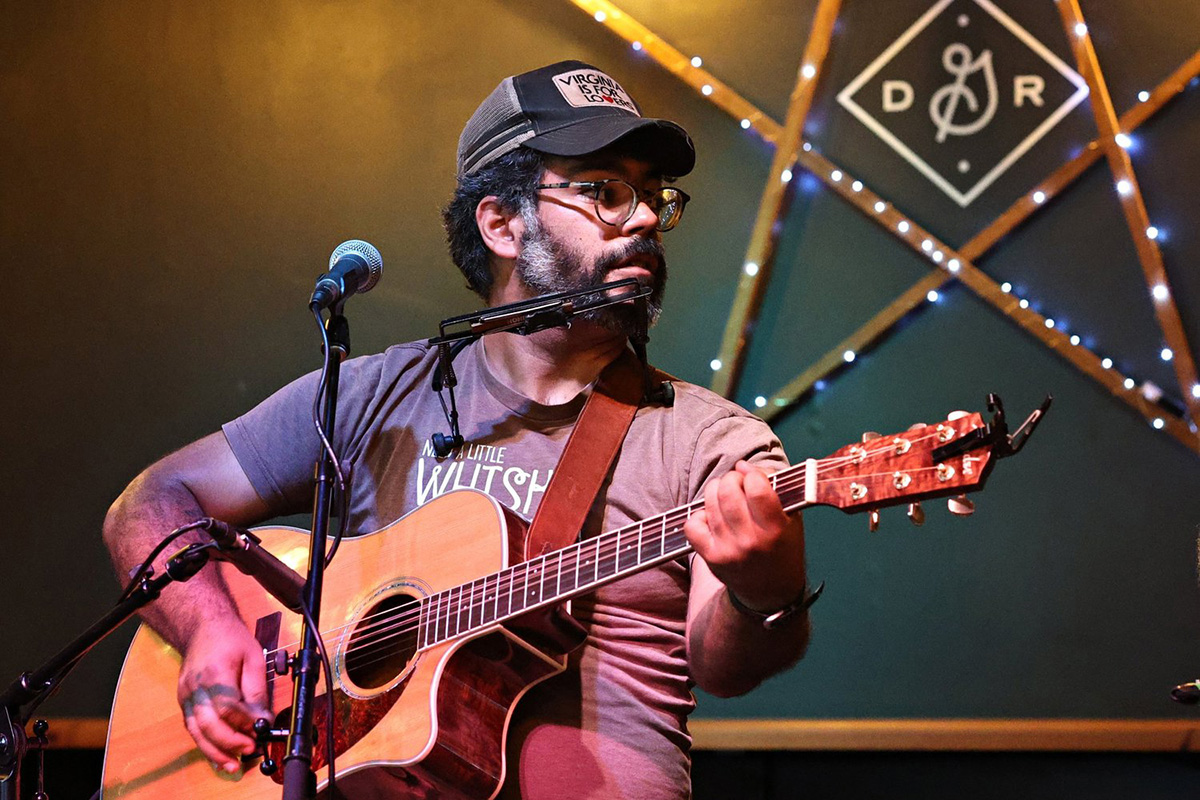
CANDLER — Few people would think of writing songs about the multi-layered, often dark and violent short stories and novels of Southern Catholic writer Flannery O’Connor.
Greensboro-based songwriter, poet and musician Colin Cutler accepted the challenge. The result was his critically acclaimed 2023 album “Tarwater,” named after the main character in O’Connor’s novel “The Violent Bear It Away.”
Cutler and his band The Hot Pepper Jam will be one of the featured performers at the third annual Kingfisher Folk Festival Saturday August 1 in Candler. Other artists include Hightop Mountain Harmony; Tolkmith, an Irish folk band made up of students from St. Joseph the Worker College in Steubenville, Ohio; sea shanty-singing pirate band Nelson’s Blood; and returning headliners The Hillbilly Thomists, a group of Dominican friars who play bluegrass and folk music.
Formed in 2024 by organizer Andrew Tolkmith, the festival benefits Canongate High School and emerged from his desire to raise awareness about the small Catholic high school while highlighting the connection between Catholic and traditional mountain cultures.
“At Kingfisher, there are two main aspects – the folk and the music,” Tolkmith told the Catholic News Herald in 2025. “Folk obviously means people, and the main goals we have tried to celebrate and cultivate at the festival are our understanding of what it means to be a human being, a Catholic creature of God and the art that we make.”
Tolkmith’s words describe what O’Connor did in her stories, and what Cutler explores through songs focused on her writing.
An Army veteran who traded his rifle for a banjo and guitar, Cutler found a home in Greensboro, where he teaches English at Guilford Technical Community College and is a vital part of the region’s folk and oldtime music community.
On “Tarwater,” the songs draw from a variety of O’Connor’s works, from the novel it’s named after to short stories like “Parker’s Back,” which follows a man who tattoos the image of Christ’s crucifixion on his back during a time of spiritual transformation.
Cutler shared his thoughts about O’Connor and Catholic spirituality with the Catholic News Herald:
CNH: What led to your interest in Flannery O’Connor?
Cutler: I first encountered her while doing undergraduate work on major Christian authors, and I knew her writing was good but didn’t know if I liked her. Then I had eight months between graduation and infantry school, and I did a self-study of her essays and letters and other work, and by the end of it I said “I get what she’s doing and I like what she’s doing.”
Her stories are focused on the human element and on revelation. She can draw an image in just a few lines. Her stuff is very dark, but I think a lot of artists inspired by her miss the undercurrent of love and questioning that is there in her work. I think her work shows a deep love for her characters and the people around her.
CNH: What is your spiritual background?
Cutler: I grew up Pentecostal, but my great-grandmother was a devout Catholic and my mom was raised Catholic. I started OCIA classes for a bit when I was over in England and attended Catholic Masses, and even though I didn’t end up coming into the Church, the faith has certainly been a big influence on me.
CNH: What shone out for you about O’Connor’s spirituality?
Cutler: I think the big difference between Protestant sensibility and Catholic spirituality is that Protestant theology tends to be more propositional – how do you answer the question of what must you do to be saved? Whereas for Catholics it’s more about the event of the Incarnation, the union of body and soul and the Word made flesh. Those two things aren’t separate, and that shows up in her art.
CNH: What do you think the Catholic faith meant to O’Connor?
Cutler: I think it was absolutely central to her identity as a person and as a writer. I think it gave her the courage and the confidence to explore the human in a way that some of her Southern contemporaries did not. I like to compare O’Connor to William Faulkner. Faulker explored these big ideas with a lot of these almost disjointed images, whereas O’Connor was more focused on telling the story and letting her ideas shine through in her depictions of humans and their actions. I think her faith also helped her writing in the aspect of how the Catholic faith places the human in relation to the divine.
CNH: How was the album received?
Cutler: The music and songs have been well received, and I’ve also heard that it’s led more people to read Flannery O’Connor. In most spaces I will at least mention her and there’s usually at least one person in the audience who says they love her. There are also a lot of people who don’t like her – she’s definitely a polarizing writer. ... Folks in the music industry also thought the album was a really cool concept, and it’s been well-received on the academic side of things. It even received a nice review in the Flannery O’Connor Review. It’s been fascinating to see how the different worlds have received it – both the folk music world and Catholic, academic and Southern literature spaces.
CNH: How would you describe the link between the Catholic imagination and folk music?
Cutler: A lot of folk songwriters are very solid storytellers, and we even see that in the words of traditional folk songs that don’t have a specific author. They are very incarnational storytellers that draw a picture while they tell a story, and there’s a lot of meaning under the words of the song. We especially see that in Black folk music where there’s a lot of coding to the meaning, where people outside of that community might understand the bones of the story but not catch all of the significance. That is also something that a lot of Catholic art carries with it – there are layers of meaning that not everyone might understand if they aren’t Catholic, but they still evoke a response.
CNH: How did you come to be a performer at Kingfisher?
Cutler: I met Andrew Tolkmith at the Catholic Imagination Conference in 2024 up at Notre Dame because I was there to give a presentation and perform with the band. Andrew saw me and liked the music and what I had to say and reached out to me.
– Christina Lee Knauss, photo by Colin Cutler Music
Don’t miss this Catholic-inspired mountain music festival
Featured performers: The Hillbilly Thomists, Colin Cutler and The Hot Pepper Jam, Hightop Mountain Harmony, Tolkmith, and Nelson’s Blood
Other activities: Vendors, dancing, food trucks and pirate-themed activities
When: Noon to 8 p.m. Saturday, Aug. 1
Where: The Oaks at Daniel Ridge, 818 Monte Vista Road, Candler
How much: $25 general admission, $35 premium seating, $75 family admission
For advance tickets and T-shirts: Go to www.kingfisherfest.com