


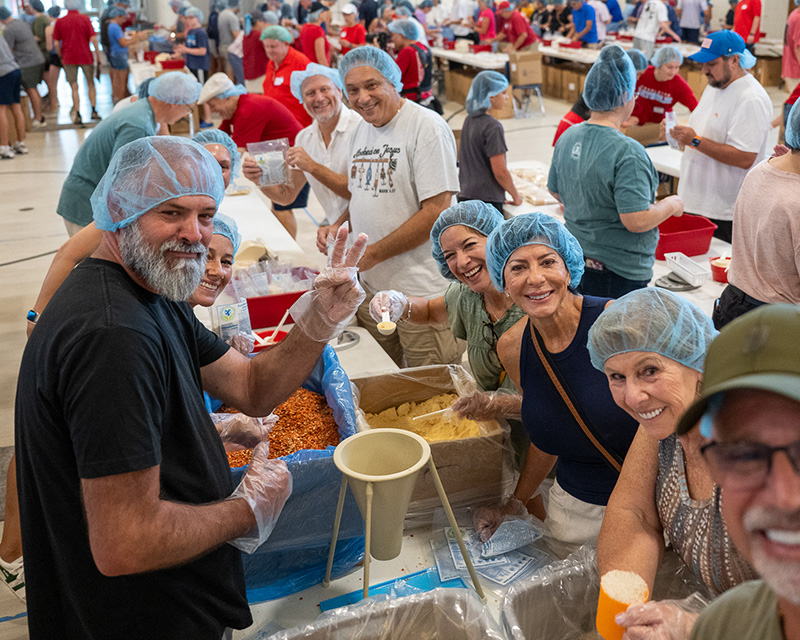
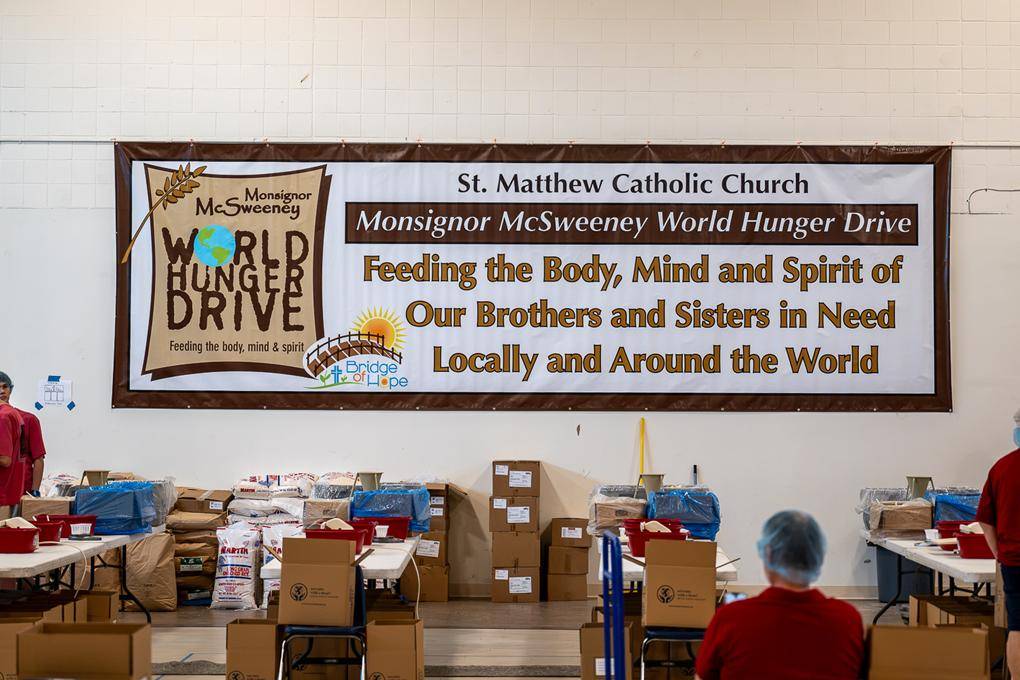
 Now in its 24th year, the Monsignor McSweeney World Hunger Drive is still going strong, attracting thousands of volunteers to help to feed people locally and in impoverished nations.(Troy C. Hull | Catholic News Herald.)MATTHEWS — Through local hurricanes, international earthquakes and government collapses, the Monsignor McSweeney World Hunger Drive is still going strong, helping to feed people locally and in impoverished nations for 24 years.
The hunger drive was never a small feat and still lives up to the expectation Monsignor John McSweeney set during the first event: “Go big or go home.”
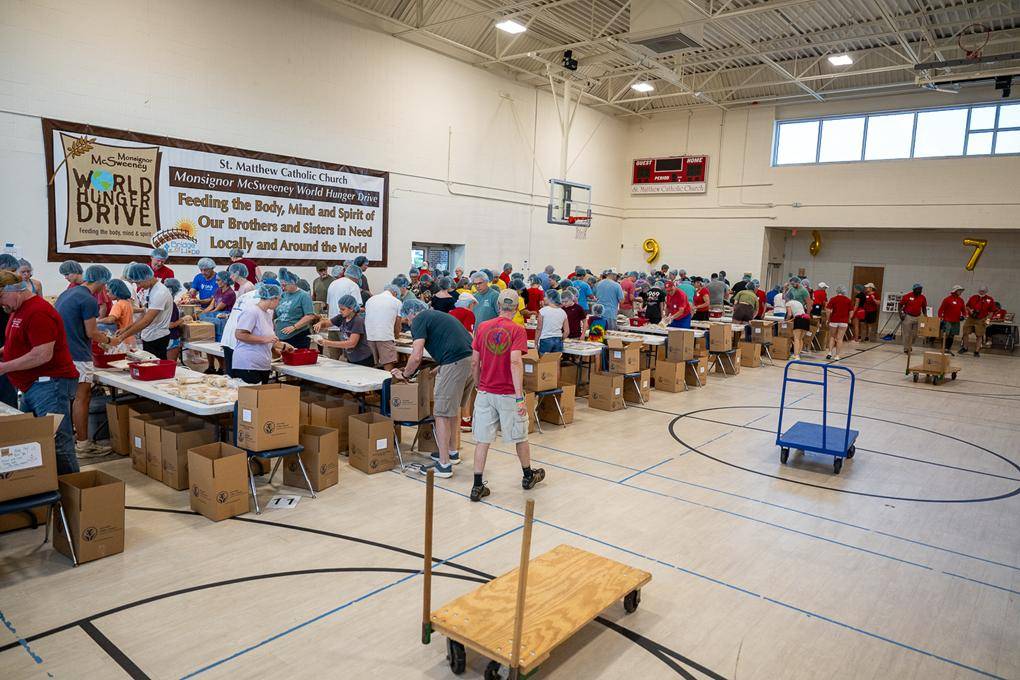
The drive is one of the nation’s largest community-driven Catholic hunger drives, drawing huge crowds to its single-site meal packing event, and this Aug. 15 was no exception.
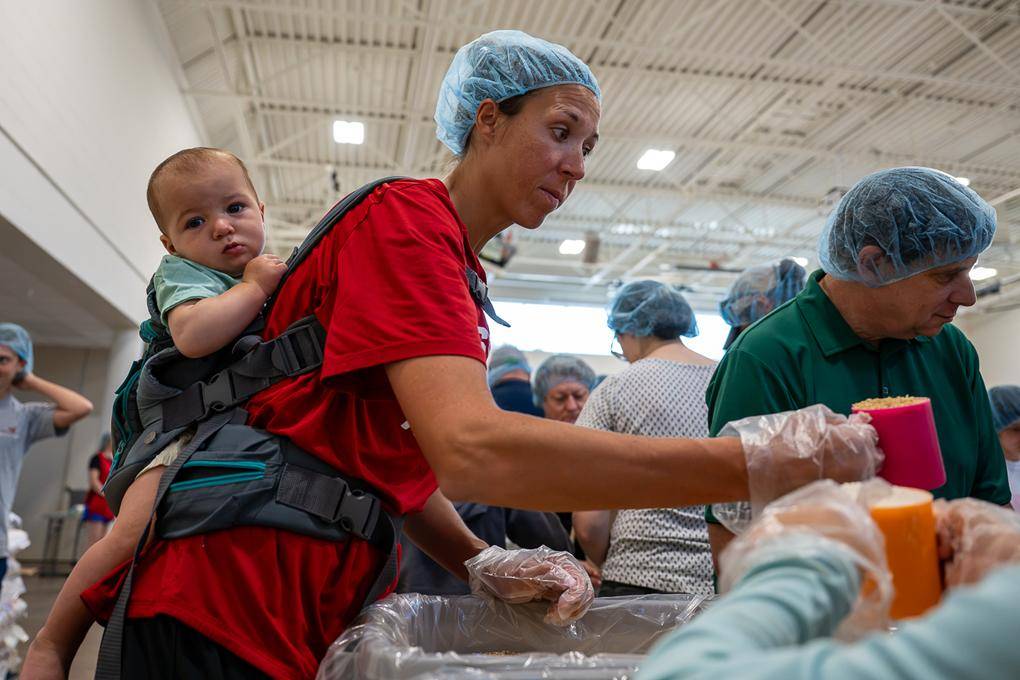
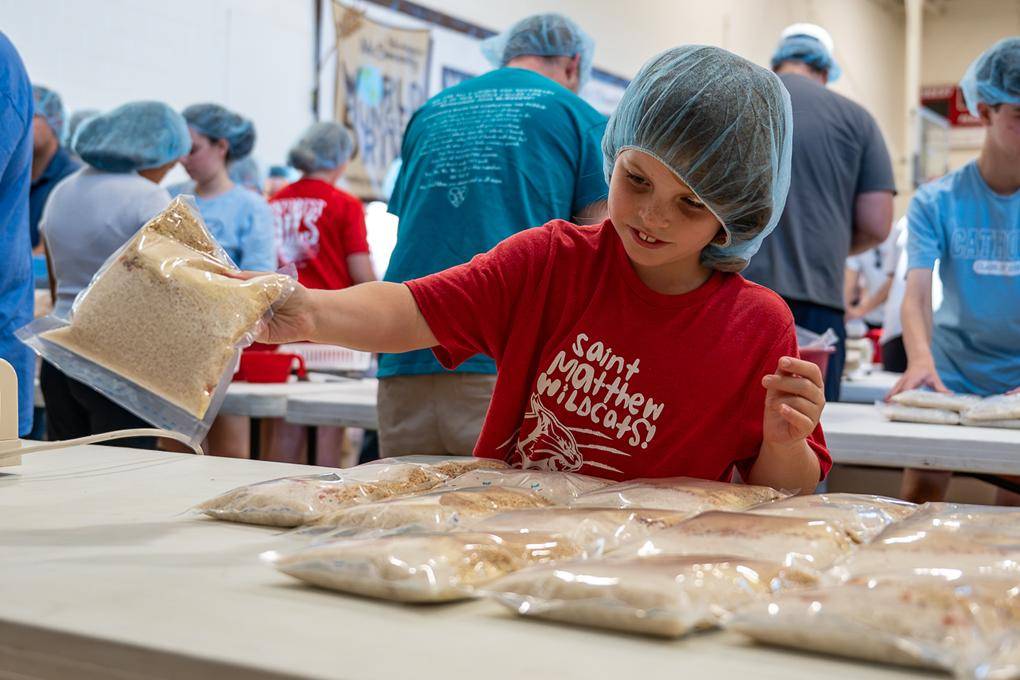
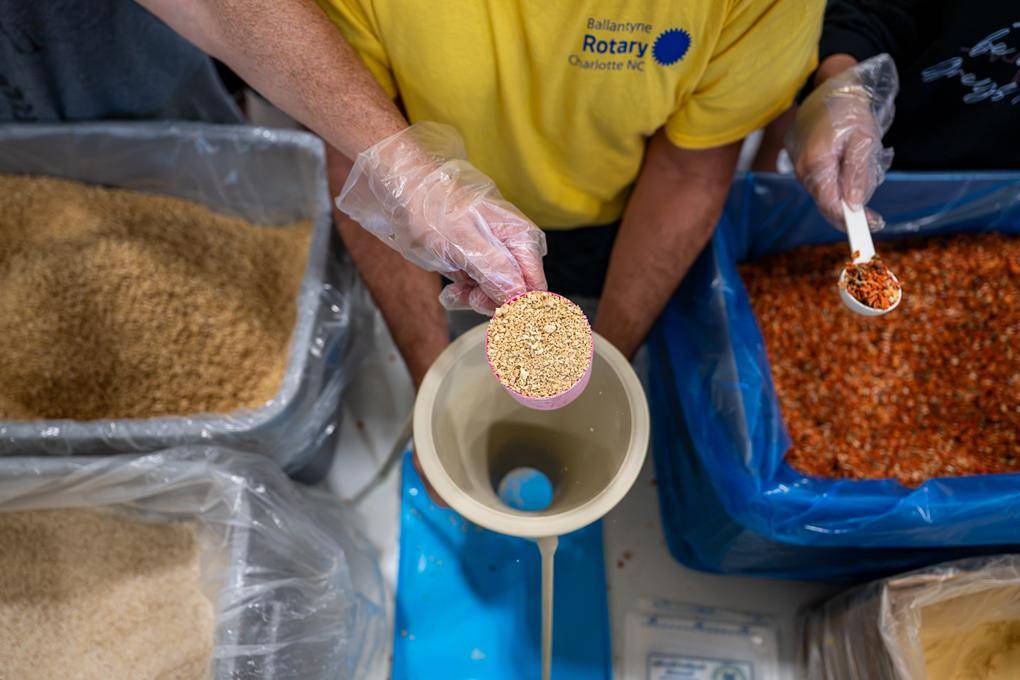
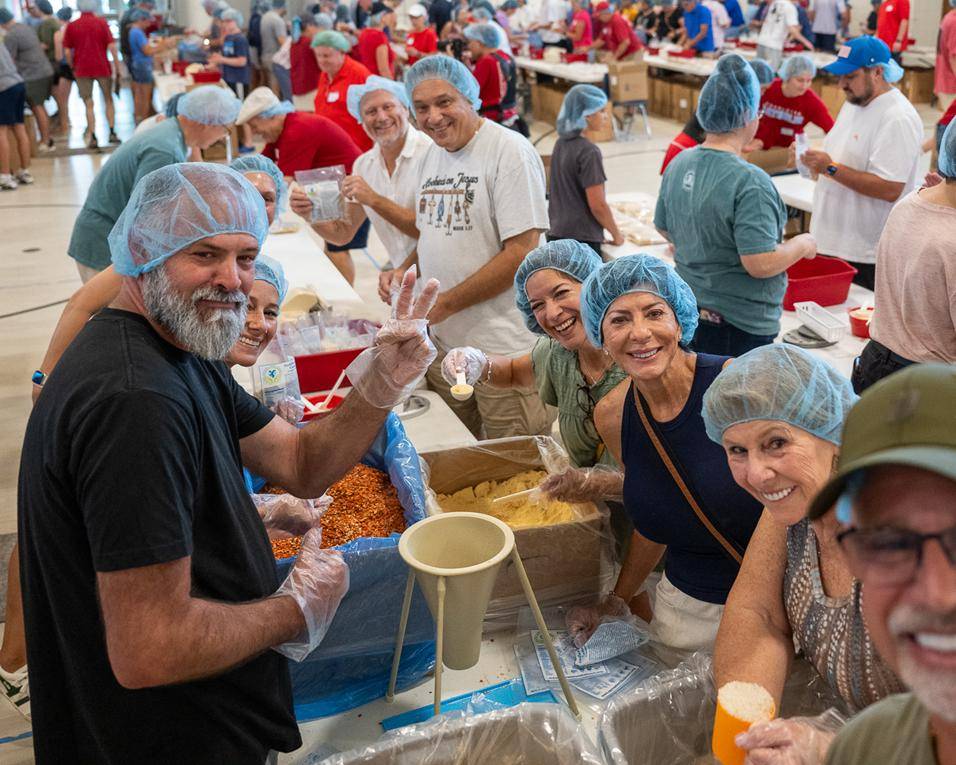
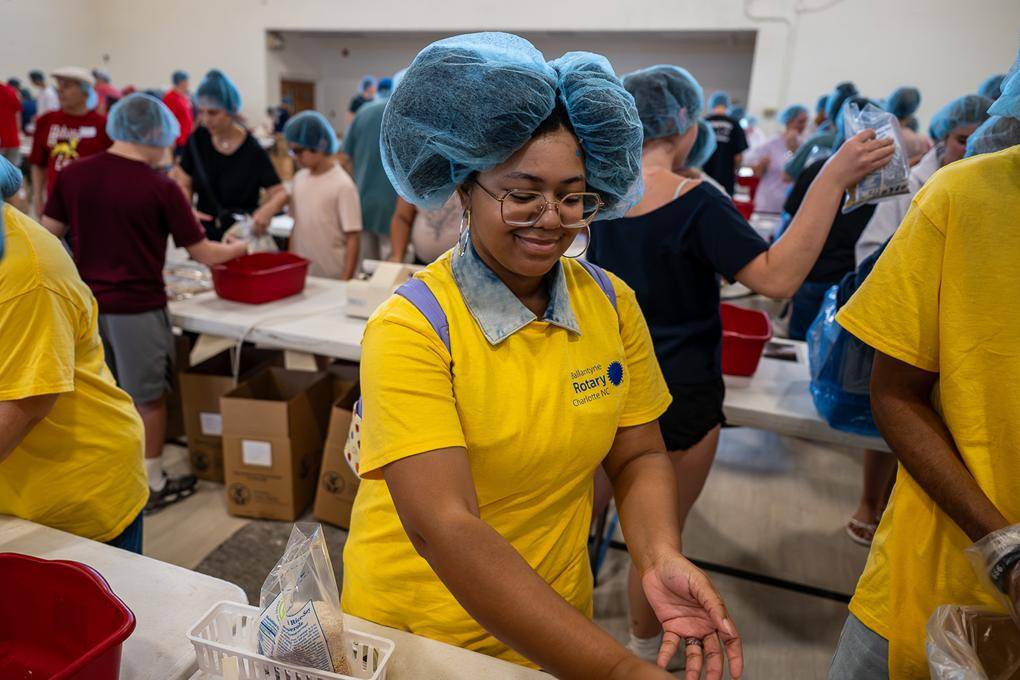
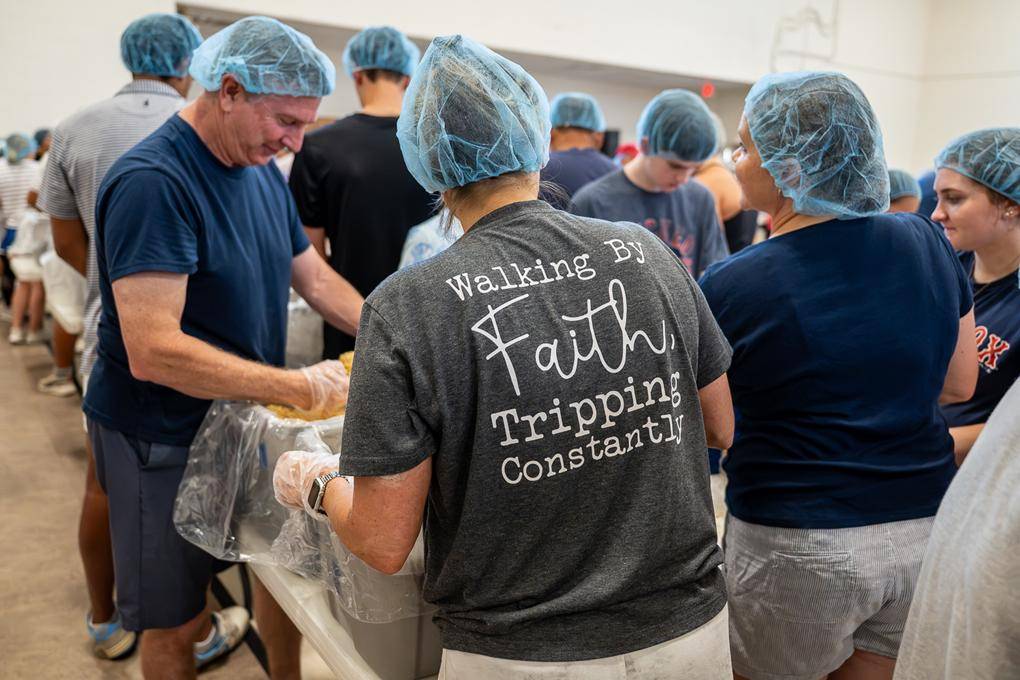
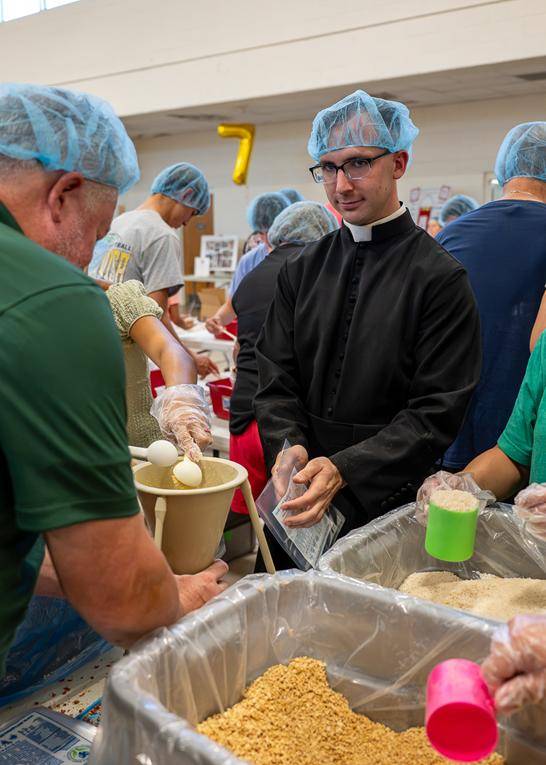
With the DJ pumping, parishioners and community members packed into the St. Matthew gymnasium found tons of reasons to sing and dance while packing more than 300,000 meals of rice, dried vegetables, vitamins and soy proteins into small plastic bags.
The production was not a one-act show but was staffed by four shifts of more than 300 energized volunteers each, that worked staggered schedules from 8:30 a.m. until clean up after the 5:30 p.m. shift ended.
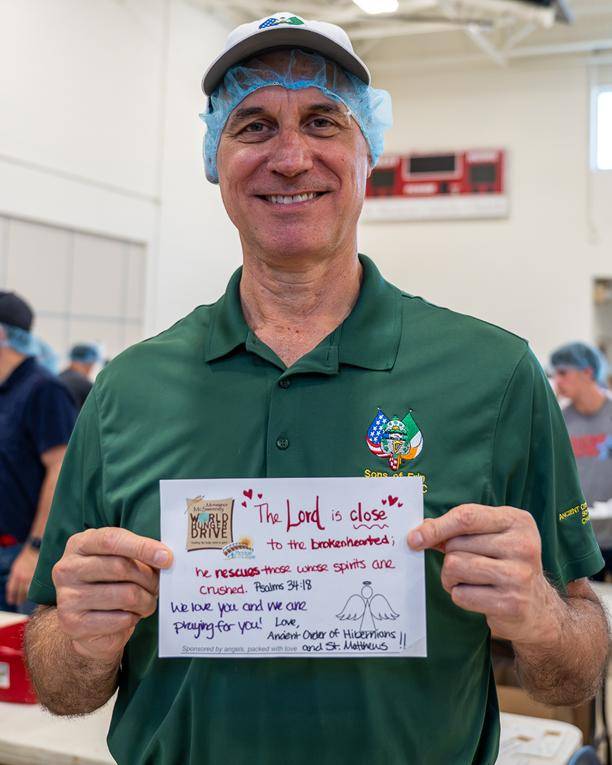
The vibe was as contagious. Vivacious parishioners did impromptu Irish jigs, danced in conga lines, and heard from their own singing sensation, Joey Santo Henry.
Henry, who has volunteered for the past 15 years along with his mother, volunteer coordinator, Maria Henry, said singing while volunteers performed such a loving act of service felt like heaven.
Maria Henry agreed, with tears in her eyes, “I have coordinated this for 10 years, and it is such a heartwarming experience every time. I can’t even express it in words. Within the first two weeks, meal pack sign-ups were full, with all 1,500 slots taken. This event has such a huge impact on our volunteers, they schedule their vacations around it.”
The meal packs will be shipped to Puerto Rico and other areas across the country. The more than $400,000 raised since July 11 will go further, helping grassroots partners in India, Venezuela and Haiti.
There are no middlemen, just dedicated parishioners who have spent most of their energy forming relationships to help their most valued guests - the poor.
Each country’s connection to St. Matthew tells another story about what can happen when people persevere in following Jesus’ commission to help others.
— Lisa M. Geraci, Catholic News Herald
More online
At www.stmatthewcatholic.org/worldhungerdrive: Register and learn more


Haiti
St. Matthew Parish and Haiti have a deep-rooted relationship that began in the 1990s through the Missionaries of the Poor (MOP) in Cap-Haïtien. The primary recipient of the first meal pack in 2003, they continue to be the heart of the ministry.
Over the years, parishioners have bought real estate in Cap-Haïtien on which St. Marc School was built, founded the nonprofit Hands for Haiti and continue to make regular visits.
Haiti’s recent uptick in gang violence has made the already destitute country even more dangerous and impoverished, creating obstacles for Steve Favory, hunger drive organizer and Hands for Haiti founder.
Currently, more than 1.8 million citizens have been displaced from the capital of Port-au-Prince, fleeing to Cap-Haïtien.
Half the population – 5.8 million people – is suffering from food insecurity. Without a government structure, the hospitals, power grid and education system are in shambles.
The murder rate is up 116% with more than 1,600 reported homicides in the first quarter of 2026, according to the United Nations Integrated Office in Haiti, while executions, sexual assaults and kidnapping are
commonplace. That has led the U.S. State Department to issue a level 4 “do not travel” advisory.
Since a container of meal packs that used to cost $4,000 to ship has increased to $50,000, the drive is monetarily supporting St. Marc School and the MOP in lieu of shipping food.
Favory refuses to let the climate dictate the appetite of his beloved 400 students, the MOP brothers, or the school. Through the turmoil, he continues to make regular trips to visit the MOP and St. Marc School’s 400 students and plans to return in September for the start of school.
“It’s still amazing how the whole country is imploding but how St. Marc School and MOP continue to build a Bridge of Hope by providing breakfast and lunch daily, medical treatment, education and faith,” Favory said.
Father Richard Ho Lung, founder of the MOP, applauds Favory’s continued efforts: “Steve is amazing. He never stops. That is what sustains hope.”
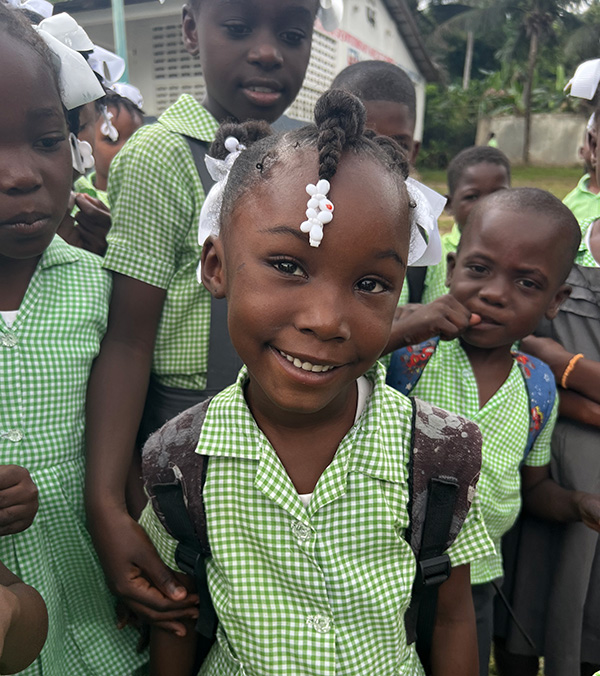 St. Marc School in Haiti was founded by St. Matthew parishioners, and the drive continues to support its 400 students.
Puerto Rico
Nine months ago, Pat McBride’s team of volunteers mapped out the most impoverished Catholic churches in the country in search for a destination to send meal packs.
“When we started having problems shipping into Haiti with the violence and the political turmoil, we wanted to find other options,” McBride said.
They found Puerto Rico, where the 43% poverty rate is roughly three times higher than the overall U.S. poverty rate, according to the U.S. Census Bureau.
“In Puerto Rico, with no import tariffs and no language barrier, it became a natural option,” McBride said.
“We kept running into the challenge of the last mile,” he said. “Meaning, we can send the food, but how do we get the food from the parish to the people who need it?”
Puerto Rico proved to be the most viable opportunity, as customs could be avoided, and with 80 percent of the population being Catholic, relationships with other Catholic organizations and dioceses could easily be formed.
Steve Favory and McBride visited a small town in the central mountains and met with Catholic nonprofit Caritas. The tilapia farms, agricultural farms and workforce advancement programs they set up in Haiti seemed like long-term possibilities in Puerto Rico.
“We can start something here and not only do the food donation for the immediate need but also help them transition from food dependency to food independence,” McBride said.
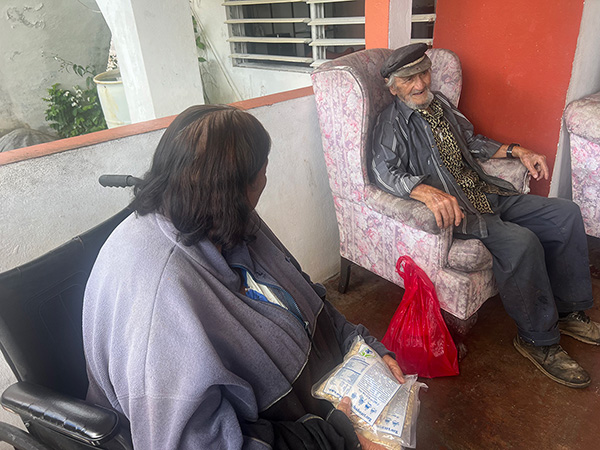 Puerto Rico is the ideal place to send food, with no customs and organizations like Caritas International in place.
Venezuela
The Monsignor McSweeney World Hunger Drive has supported St. Francisco de Asís Parish in Naiguatá, Venezuela, for years but has increased efforts since the area was devastated by twin 7.2 and 7.5 earthquakes on June 24 that have so far claimed 6,300 lives, with tens of thousands still missing.
Over the past month, St. Matthew has sent $27,000 in emergency funds for immediate needs.
In the past, the parish used donations for a soup kitchen to feed the destitute. Now, the church, guided by Father Martín Vega, is a central outpost aiding the community.
Devastation continues to be rampant through continuous landslides and aftershocks, aggravating the already dilapidated tourist town. As families grieve losses and try to rebuild their homes, most are doing it on limited or no cash on hand, as commercial tourism, the lifeblood of the former community, is at a complete standstill.
The church is delivering water, personal hygiene and sanitation kits, wheelchairs and medical equipment and clothing street by street in the affected communities. Medical care and mental health needs are being addressed. Mass, sacraments, adoration, and, unfortunately, too many funerals are being celebrated. The soup kitchen is serving 150 breakfasts and lunches a day.
The road to recovery may be long, but with parishes like San Francisco de Asís and St. Matthew coming together, the future is brighter.
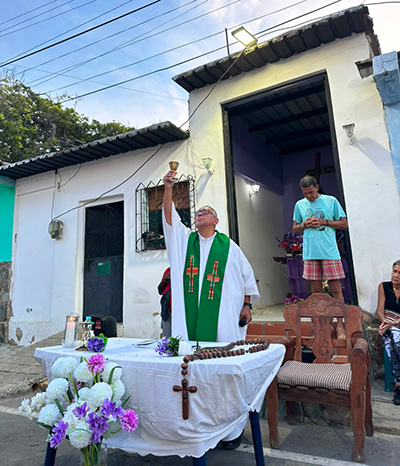 St. Matthew sent funds directly to St. Francis de Asís Parish in Naiguatá after two earthquakes killed thousands.
India
Father Binoy Davis, who served at St. Matthew since 2015 and was recently reassigned to Immaculate Conception in Forest City, has a heart for India and a heart for the poor.
He was born in Kerala, where most Indian Catholics live, but went to the Diocese of Satna to evangelize and serve.
Although the mission is ultimately to save souls, Father Davis’ diocese saw the desperate need to feed the poor and shelter the homeless in the Hindu community that surrounded them.
“When I saw the work they were doing in Haiti and in other parts of the world, I, myself, requested their help as well,” Father Davis said. “They were happy to help my diocese and my bishop.”
Today, the diocese uses funds to feed, shelter and educate 50 boys and 60 elderly homeless through a hostel and adult orphanage.
Father Davis went back this May and was delighted to see the progress.
“These people are from very poor families,” Father Davis said. “They are our needy, our poor, and our homeless. The elderly have no family. They are refused. And this ministry is there for them.”
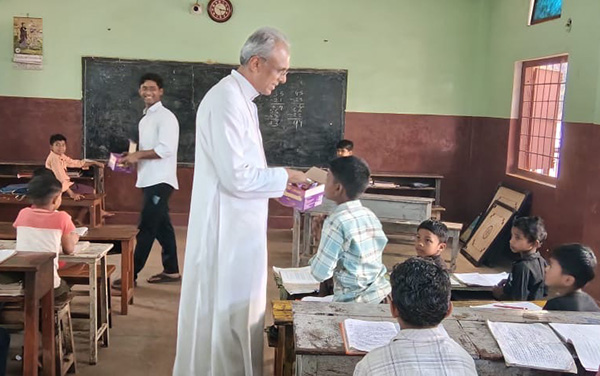 The Diocese of Satna in India uses World Hunger Drive funds to house 50 boys and 60 elderly homeless individuals.