


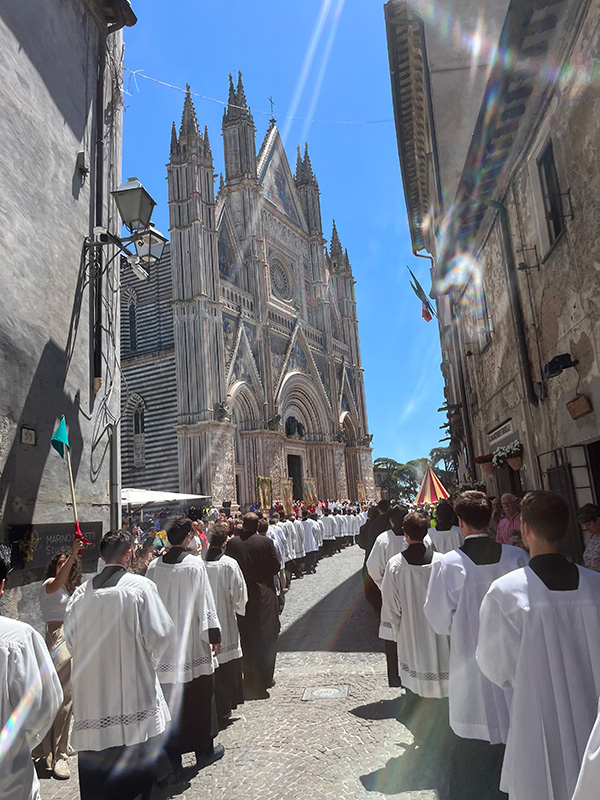
ROME — Four seminarians from the Diocese of Charlotte who are studying overseas found time during their spring semester to combine rigorous academics with some profound spiritual experiences.
Elijah Buerkle, John Harrison, Gabriel Lugo and Ronan Ostendorf are students at the Pontifical North American College in Rome, studying theology and philosophy in both English and Italian. Buerkle will begin his second year in Rome when classes resume for the fall semester in October, while the other three will begin their third year of study in Italy.
During the spring, all four men continued exploring sacred and historical sites in Italy and got to take part in some of the country’s most treasured Catholic traditions.
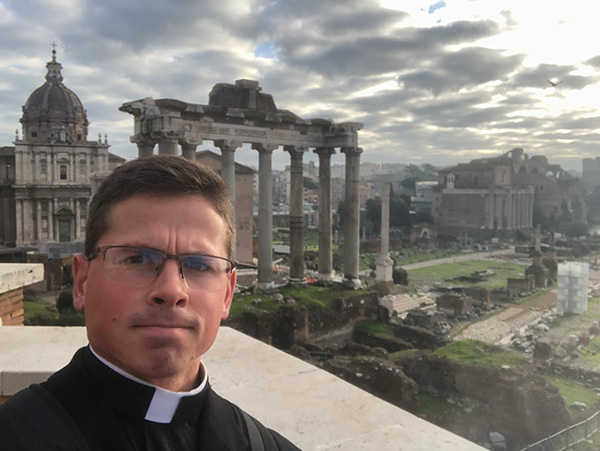
Elijah Buerkle is proud to have completed his first year of overseas study, calling it a year “of blessings and opportunities to grow and trust in God.”
Along with his academic work, Buerkle’s year was full of memorable spiritual experiences, with the highlight of the semester for him being his participation in the Lenten Station Church pilgrimages in Rome.
Buerkle said Romans have a tradition of visiting a specific designated church for prayer and Mass every day during Lent. He joined priests and seminarians from the college in leaving campus at 6:15 a.m. to walk in silence 30 to 45 minutes into the city to join other pilgrims at the “church of the day.”
“I was not originally planning on walking every single day, but there was something so beautiful about walking through the still sleeping city of Rome under cover of darkness to go to these ancient churches built over the tombs of the Roman martyrs and celebrate Mass just as the sun began to rise,” he said.
Those morning walks frequently took Buerkle by the ruins of the Roman Forum, which was the center of day-to-day life in ancient Rome.
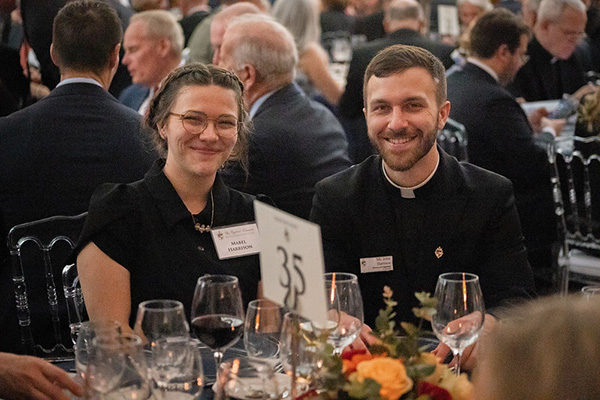
John Harrison got to share some the beauty and history of Rome with his younger sister Mabel Harrison, who joined him there while she studied at the Pontifical University of St. Thomas Aquinas, commonly known as the Angelicum.
“I made it a priority to spend time with her, getting dinners, meeting her friends, attending Mass and traveling with her,” Harrison said. “I got to watch her grow through the whole experience and be there for her during the difficult times. But the greatest moments were the quiet ones, kneeling at the tombs of the saints.”
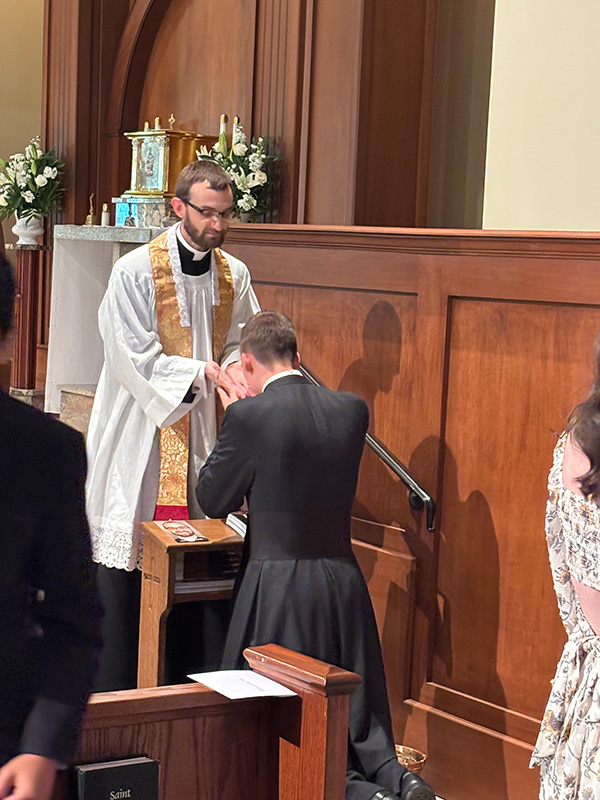
Gabriel Lugo spent a busy spring semester studying and then at very end, as summer approached, he got to make a special trip back to North Carolina to serve at the ordination Mass of his brother, Father Michael Lugo, on May 30.
“I was happy to be present, and it made me eager for my own ordination to the transitional diaconate next year!” he said.
Right before his journey home, Lugo made a pilgrimage to Nevers, France, where St. Bernadette is buried. He also saw a memorial to a priest who has become a role model for him during his studies.
“In a niche on the wall is buried the heart of the first North Carolinian to be ordained a priest, Father Thomas Frederick Price,” Lugo said. “I have become devoted to him while in Rome, since he was a missionary to the people of our home state before founding the Maryknolls and dying in China. Although I’m in Rome studying, I hope to return soon to spread the Gospel at home with a portion of his zeal!”
Lugo noted that Father Price survived many challenges during his life, including a shipwreck, and a cause for his sainthood has been opened in the Diocese of Raleigh.
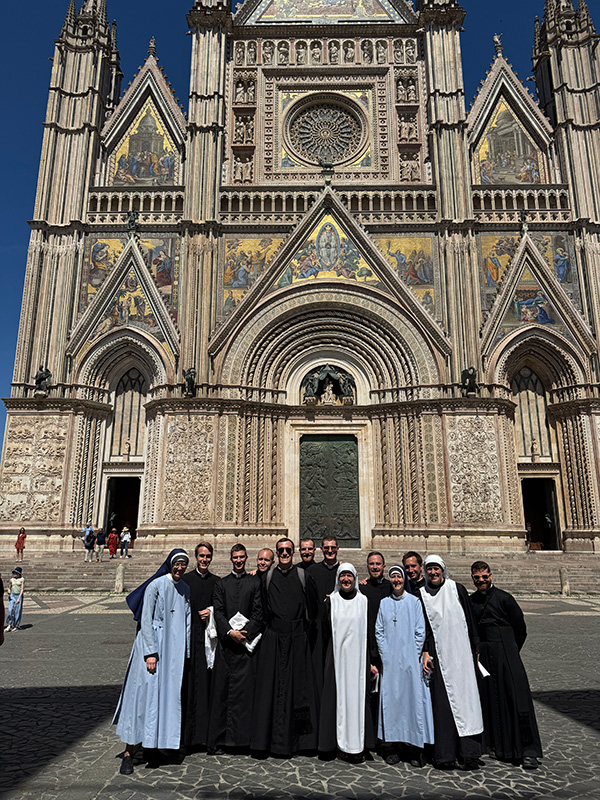
Ronan Ostendorf had two memorable experiences for the June 7 feast of Corpus Christi. He participated in and served during celebrations in the Italian cities of Bolsena and Orvieto, where the feast day and the tradition of Eucharistic processions originated.
Ostendorf enjoys recounting this history of the feast of Corpus Christi, which originated with a 1263 Eucharistic miracle that took place during the visit of a German priest who was having trouble fully believing in the real presence of Christ in the Eucharist.
While the priest was celebrating Mass, the host bled during the words of consecration and dripped on the linen cloth – called a corporal – underneath. The following year, Pope Urban IV promulgated the feast of Corpus Christi.
“This corporal is still reverently processed through the streets of Orvieto with exceedingly great fanfare, accompanied by many priests and religious from all over the world,” he said.
He said the procession in Bolsena was also a beautiful experience.
“The locals spend hours carefully assembling devotional images made out of flower petals to beautify the streets upon which the bishop treads as he processes with the monstrance,” Ostendorf noted. “And not a soul walks on them until the bishop does so with Our Lord.”
— Christina Lee Knauss