


 Editor’s note: This is part of a series profiling great American Catholics ahead of the July 4 celebration of the 250th anniversary of the signing of the Declaration of Independence.
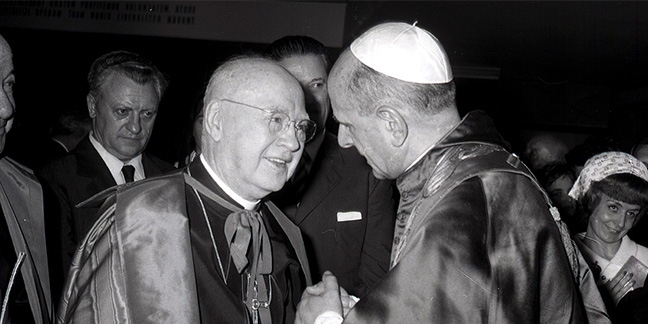
Many cardinals have had books written about them, but few have become the fictionalized heroes of best-selling novels. Cardinal Francis J. Spellman, archbishop of New York from 1939 to 1967, was one – possibly the only one.
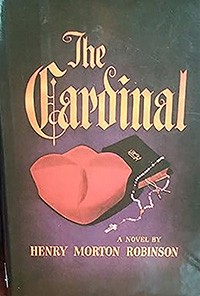
The novel was called “The Cardinal.” The work of Catholic author Henry Morton Robinson, it topped the best-seller list for many months after its publication in 1950. Later it was made into a movie.
With many embellishments, the story mirrored the real-life career of Cardinal Spellman – hard-fought climb to the top of the hierarchical ladder, trusted adviser to a pope and a president, behind-the-scenes unofficial diplomat engaged in sensitive wartime missions.
When Time magazine, marking his elevation to cardinal, featured his cherubic features on the cover of its Feb. 25, 1946, issue, the artist situated the dome of St. Peter’s Basilica and a spire of St. Patrick’s Cathedral in the background.
They might have tossed in the White House, too – for Cardinal Spellman embodied the fusion of Americanism and Catholicism.
Roots of faith
Francis Joseph Spellman was born May 4, 1889, in Whitman, Massachusetts, the oldest of five children of William and Ellen Conway Spellman. Young Francis attended the local high school, where he was manager of the baseball team, and Fordham University in New York, graduating in 1911.
By then he’d decided to become a priest. As a seminarian of the Boston archdiocese, he studied at the Urban College in Rome, exhibiting a talent for cultivating friendships with men who would rise to high positions in the Roman Curia.
Ordained a priest in 1916, he returned to Boston. There he appears to have had a falling-out with Cardinal William O’Connell, who ruled the archdiocese with an iron hand. Father Spellman spent the next several years in a series of temporary assignments.
The church’s James Bond
Even so, he kept up his Roman contacts. The breakthrough came in 1925, when he accompanied a pilgrimage group to Rome. There he secured a post in the Vatican Secretariat of State.
He also made friends with American Catholics Count Enrico Galeazzi, a Vatican insider, and Archbishop Eugenio Pacelli.
When Pope Pius XI in 1931 issued an encyclical critical of Benito Mussolini’s fascist regime, the fascists wouldn’t allow its publication in Italy. Father Spellman’s superiors assigned the young American priest to smuggle the document to Paris.
In 1932, Father Spellman was named auxiliary bishop of Boston and ordained in St. Peter’s by newly appointed Cardinal Pacelli. While he was a hero in Rome, it was a different story in Boston. Cardinal O’Connell sent him to a parish with as little public visibility as possible.
But Bishop Spellman was not easily thwarted. With funding from his friend, Boston multi-millionaire Joseph P. Kennedy, he organized a 1936 U.S. visit by Cardinal Pacelli. A high point of the trip was a meeting between the cardinal and President Franklin Roosevelt.
Cardinal Pacelli soon became Pope Pius XII and appointed Spellman archbishop of New York.
Advisor to presidents and popes
As the world plunged into war and the United States edged toward entering the conflict, Roosevelt turned to Archbishop Spellman as an adviser on Catholic affairs. At the end of 1939, Pope Pius XII named him to the post of Military Vicar.
In January 1943, Archbishop Spellman prepared for the first of what would be a series of annual trips to visit servicemen overseas. Roosevelt gave him an additional mission whose nature became clear when on Feb. 12 he met with Spanish dictator Francisco Franco. The session was credited with helping ensure Spanish neutrality during the war.
During this remarkable trip, Archbishop Spellman lunched with Winston Churchill in London. In Rome, he appears to have met with high-ranking officials. In Istanbul, he made the acquaintance of Archbishop Angelo Roncalli – later, Pope St. John XXIII. Returning to the United States, he urged Roosevelt to treat Rome as an “open city” and refrain from bombing it – a plea that had only partial success.
During the war, Pope Pius named no new cardinals, but it was no surprise when Archbishop Spellman was part of the first post-war class, elevated to the College of Cardinals on Feb. 18, 1946.
In the years that followed, Cardinal Spellman was a champion of anti-communism. At the Second Vatican Council, he supported ecumenism and strongly backed Vatican II’s endorsement of religious liberty.
He died in New York on Dec. 2, 1967.
— Russell Shaw, OSV News