 Everyday people, including Catholics, and churches can help those experiencing a mental health crisis and save lives, according to experts.
During National Suicide Prevention Month in September, ministry leaders and crisis experts are listing practical steps that individuals, families and churches can take to help.
In the United States, nearly 50,000 people died by suicide in 2023, which amounts to about one person every 11 minutes, according to numbers from the U.S. Centers for Disease Control and
Prevention. The government agency reports that many more think about or attempt: An estimated 12.8 million adults seriously considered taking their lives in 2022. The numbers are rising: rates increased roughly 36% between 2000 and 2022.
In the hopes of saving more lives, four experts shared their advice. Their comments come before November, when the pope’s prayer intention is for the prevention of suicide.
1. Take mental health seriously
These experts emphasized the importance of mental health.
“If you’re thinking of suicide, treat that the same way you would if you were having chest pains or maybe tingling in your arms,” said Deacon Ed Shoener, president of the International Association of Catholic Mental Health Ministers, a lay association dedicated to helping people with mental illness and their families.
“Similarly, if you’re having thoughts of suicide, don’t feel ashamed, just be concerned and make it a point to talk to your doctor, or if you know a therapist – but talk to someone about it,” he said.
2. Know the warning signs.
Learning the warning signs can help, according to experts like Wendy Martinez Farmer, vice president of 988 strategy, quality improvement and clinical standards at Vibrant Emotional Health.
Her nonprofit runs 988 Suicide & Crisis Lifeline, which provides 24/7 call, text and chat access to crisis counselors.
She listed signs that “may help determine if an individual is at risk,” especially if the behavior is new, has increased, or seems related to a painful event, loss or change, she noted. Those include:
- Looking for a way to harm themselves.
- Talking about feeling hopeless.
- Talking about feeling trapped or in pain.
- Talking about being a burden to others.
- Increasing use of alcohol or drugs.
- Withdrawing or isolating themselves.
3. Talk about it
These experts encouraged people to reach out to those who may be having a mental health crisis.
“If you think someone is suicidal or thinking of that, don’t be afraid to ask them,” Deacon Shoener said. “One, it signals that you’re open and willing to talk about mental health and matters such as that – and it also says you’re there, ready to help them.”
Elizabeth Leon, director of family support at Red Bird Ministries, a Catholic grief support ministry that runs a program called “Remember,” recommended practicing what to say. She suggested phrases such as, “I am concerned that you are so unhappy. Are you thinking about suicide?” and “Do you feel safe to be alone right now?”
Many people having a mental health crisis “will not ask for help, so having the courage to reach out to them is critical,” said Leon.
4. Don’t be afraid to act
Sometimes action is needed, experts said. Marian Sister Kathryn Maney, director of Red Bird Ministries’ “Remember” program, advised, “If someone expresses struggle with suicidal ideation, listen non-judgmentally and stay with them until they find help.”
If loved ones are exhibiting warning signs, Martinez Farmer also suggested, “Remove means, like weapons or pills.”
5. Use resources
These experts wanted people to know they are not alone. Among other resources, Sister Kathryn and Martinez Farmer recommended 988 Lifeline, which helps millions of people every year.
6. Act as a church to make a difference.
“Religious communities can be places of solace, where people turn for guidance through difficult times,” Martinez Farmer said. “Both the clergy and congregants can play a role in building a culture where everyone feels safe, seen and supported by leading with compassion, listening with care, serving one another and fostering belonging.”
— Katie Yoder, OSV News
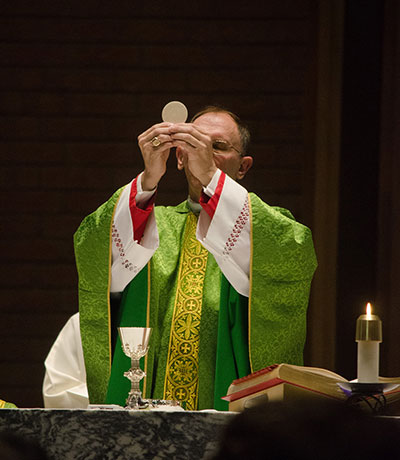 The real presence of Christ in the Eucharist is a doctrine – an official teaching of the Catholic Church – and a profound mystery. With the words of consecration, the whole of Christ is truly present – Body, Blood, Soul and Divinity – under the appearances of bread and wine.
The doctrine is based upon the words of Jesus Himself when He instituted the Eucharist. Jesus took the bread and said, “This is my body” (Mt 26:26), and He took the cup filled with wine and said, “This is my blood” (Mt 26:28). When Jesus said, “This is my body,” He declared that the bread actually is His Body, and that He is really present.
We accept and believe what Jesus said as a matter of faith. There is no scientific evidence, definite proof or factual explanation. We take Jesus at His word because He is truth (Jn 14:6), He came into the world to testify to the truth (Jn 18:37), and the words that He spoke are spirit and life (Jn 6:63). St. Cyril of Alexandria wrote, “Do not doubt whether this is true, but rather receive the words of the Savior in faith, for since He is truth, He cannot lie.”
The words of Jesus are clear and unambiguous, yet the doctrine of the Real Presence is questioned and doubted by some, and challenged, ridiculed or rejected by others. Recent public opinion polls have reported an alarmingly high percentage of those who claim to be Catholic who do not believe in the Real Presence. Other Catholics have wavered and their faith has eroded because of personal uncertainty, or because they have been swayed by the secular press, the teachings of misguided theologians or the objections of non-Catholic Christians.
There are a number of faulty explanations that are contrary to the Catholic doctrine of the Real Presence: that the bread and wine remain bread and wine and that there is no change; that they become the spiritual presence of Christ, not the actual presence; that they become a symbol that represents Christ’s presence; that they are a reminder, memento, or foreshadowing of Christ; that they become more significant or important spiritually; or that they are simultaneously Christ’s body and blood but also ordinary bread and wine.
Over the centuries, some non-believers have attacked the Catholic belief in the Real Presence with claims that it is impossible, ridiculous or superstition. During outdoor Eucharist processions, some spectators hurled taunts and insults, and their behaviors were so disrespectful that the processions were taken off the streets and moved back into cathedrals and churches to uphold and protect the sanctity of the Eucharist.
In the face of questions, misunderstanding and attack, the Church has defined, defended and reinforced its teaching on the Real Presence. St. Ambrose, who lived in the fourth century, wrote, “Could not Christ’s word, which can make from nothing what did not exist, change existing things into what they were not before?”
The doctrine was enunciated by the Fourth Lateran Council in 1215 and reaffirmed and rearticulated by the Council of Constance in 1415. During the upheaval of the Protestant Reformation, the Council of Trent declared in 1551, “By the consecration of the bread and wine there takes place a change of the whole substance of the bread into the substance of the Body of Christ our Lord.”
In his 1965 encyclical “Mysterium Fidei,” Pope Paul VI wrote, “The presence is called ‘real’ … it is a substantial presence by which Christ, God and man, makes Himself wholly and entirely present.”
Father Michael Van Sloun is the pastor of St. Bartholomew Church of Wayzata, Minn., and he blogs at www.catholichotdish.com. This article was originally published by The Catholic Spirit, the newspaper of the Archdiocese of St. Paul and Minneapolis.
Learn more
At www.ewtn.com/catholicism/teachings/holy-eucharist-43: Learn more about Church teaching on the Eucharist and, the institution of the Eucharist in sacred Scripture, and read excerpts from Church documents on the Holy Eucharist, including Pope Paul VI’s encyclical “Mysterium Fidei” noted above
At www.therealpresence.org: Read about reported Eucharistic miracles and download resources and prayers for Eucharistic devotion
Pew survey: Majority of Catholics don’t believe in ‘Real Presence’
WASHINGTON, D.C. — A new study about the level of Catholic belief in the real presence of Jesus in the Eucharist showed that a majority of Catholics do not believe that the bread and wine used at Mass become the Body and Blood of Christ.
The Pew study, issued Aug. 5, showed that 69 percent of all self-identified Catholics said they believed the bread and wine used at Mass are not Jesus, but instead “symbols of the body and blood of Jesus Christ.” The other 31 percent believed in the real presence of Jesus in the Eucharist, known as transubstantiation.
“Most Catholics who believe that the bread and wine are symbolic do not know that the Church holds that transubstantiation occurs,” said Gregory A. Smith, associate director of research at Pew Research Center in Washington. “Overall, 43 percent of Catholics believe that the bread and wine are symbolic and also that this reflects the position of the Church. Still, one in five Catholics – 22 percent – reject the idea of transubstantiation, even though they know about the Church’s teaching.”
The numbers who believe in transubstantiation are higher among Catholics who go to Mass at least once a week, but are hardly overwhelming. About five of every eight churchgoing Catholics believe in the Church’s teaching of transubstantiation.
Split among the 37 percent who don’t believe that the Communion bread and wine actually become the body and blood of Christ are 23 percent who don’t know what the Church’s teaching is, and 14 percent who know the Church’s teaching but don’t believe it, Smith said.
According to Pew’s figures, a majority in all age groups believe the bread and wine used at Mass to be symbolic, and the majority grows larger as the age group grows younger. Catholics with a high school education or less are less likely to believe in transubstantiation, Hispanic Catholics believe in it less than whites, and women believe in it less than men.
— Mark Pattison, Catholic News Service
 Everyone passing away leaves behind material traces of his or her life. The existence of a Jewish man, called Jesus of Nazareth, is supported by strong historical evidence. The question therefore is raised: Are the various artifacts associated with His life truly authentic?
The history of relics – authentic or fake – is an amazing, fascinating chapter of Christian history through the centuries, especially the relics of Jesus Christ, which remain the most venerated and famous.
Here is a look at several of these holy artifacts that have survived to the present:
The holy cross
Martin Luther once said that “one could build a whole house using all the parts of the True Cross scattered around the world,” mocking the Catholic tradition of venerating relics and pilgrimages to places where they were located.
This is not true. According to research carried out in the 19th century, all the known fragments of the holy cross amount to less than one-ninth of its original volume.
The history of the holy cross begins with Constantine the Great, the first Christian emperor of Rome, who sent his mother Helena to Jerusalem.
On Sept. 14, 320, which would become the feast of the Exaltation of the Holy Cross, Helena discovered three wooden crosses and three nails in an old cistern not far from Golgotha, where Christ was crucified.
She divided Jesus’ cross into three pieces to be sent to Rome, Constantinople and Jerusalem. Even the titulus, stating “Jesus of Nazareth, King of the Jews,” as stated in St. John’s Gospel, was divided into two pieces.
Upon her return to Rome, she converted a part of her house into a chapel to host the relics she had brought back: a fragment of the cross, one half of the titulus and the three nails. Today, this is the site of the Basilica of the Holy Cross in Jerusalem, although in 1629 some of the relics were transferred to the newly reconstructed St. Peter’s Basilica by Pope Urban VIII.
The other two parts of the cross were divided again into smaller parts, currently spread throughout Europe.
It was common to divide a relic into smaller pieces in the belief that even the smallest fragment had the same sacred power as the whole relic.
The holy nails
How are we to establish which are the true ones, given that there are 36 “holy nails” in Europe, but only three of them nailed Jesus to the cross? Unexpected help came in 1968 from an archaeological discovery near Jerusalem.
There, four tombs were excavated and three nails found near the body of a young man, crucified between 6 and 65 A.D. They are rectangular in shape, 16 centimeters long and 0.9 centimeters wide at their thickest point. Comparison suggests that some “holy nails” are not genuine, since some are too long or made of silver.
The oldest sources say Helena discovered three nails of Jesus’ cross in Jerusalem. The first one is venerated today in the Roman Basilica of the Holy Cross in Jerusalem. The second nail was brought to Constantinople in 1354 by a Venetian merchant, Pietro Torrigiani.
The fate of the third nail is more difficult to clarify. According to Theodoret of Cyrus, part was embedded in the helmet of Constantine and another part melted into his horse’s harness.
There are two places where the emperor’s harness is venerated – Carpentras, France, and Milan, Italy. In 1576, Bishop Charles Borromeo, a leading figure of the Counter-
Reformation, carried the relic three times through the streets of Milan, praying for the end of a deadly plague. Since the plague ended, they had no doubt: the holy nail made the miracle.
The Longinus spear
 According to the legend, the Roman soldier Longinus was cured of cataracts when he pierced the side of Jesus on the cross and the blood and water flowed out. Longinus was later baptized and martyred.
Pilgrims reporting from the Holy Land mention his spear up to the eighth century. The history of this relic goes on from Constantinople. Its ruler, Baldwin II, was forced to sell the spear staff to King Louis IX of France in order to collect resources to defend his Empire.
Two centuries later, Constantinople was invaded by Ottoman Turks led by Mehmed II on May 29, 1453. In 1492, Sultan Bayerid II proposed an agreement to Pope Innocent VIII: to welcome the sultan’s brother, Cem, a dangerous pretender to the Ottoman throne, to Rome. The agreement was that the brother could remain in Rome in exchange for the return of the Longinus headspear.
The relic arrived in Rome from Ancona, an Italian city on the Adriatic Sea, delivered by two cardinals. Pope Benedict XIV, in the 18th century, had many doubts on its authenticity. He asked the king of France to send the spear’s staff to Rome to verify the authenticity. The two pieces fit together perfectly.
The crown of thorns
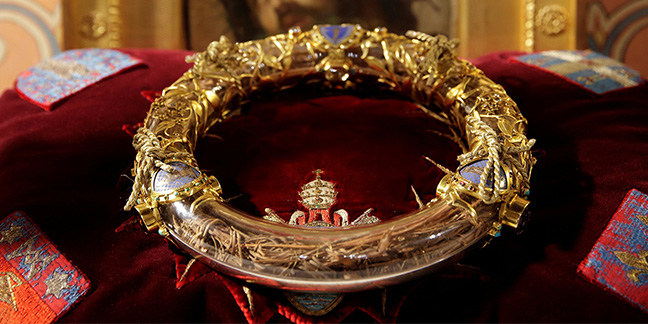
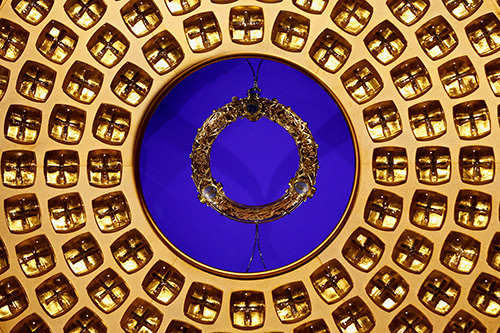
In 1870, Charles Rohault de Fleury, a French architect, counted 139 thorns throughout Europe venerated as belonging to Christ’s crown of thorns. At least half of them are fake relics on the basis of studies carried out in Paris, where the true crown has been located for almost 800 years.
The hoop of the crown, about 12 centimeters large, is made of Juncus balticus, a plant species typical of the Eastern Mediterranean basin. According to some botanists, there were no more than 50 or 60 thorns in the crown.
There is a noteworthy clue in favor of the authenticity of the thorns: In the famous Turin shroud, scientists discovered a very high concentration of pollen grain from Gundelia tournefortii, a species of thistle only found in Judea, around the head area on the linen. This same thistle is one of the plants used in the crown of thorns.
When Jesus was taken down from the cross, it is likely that a disciple took the crown, hiding it somewhere in Jerusalem, where it remained a secret until the Roman Emperor Constantine granted religious freedom to Christians in 313.
Then in 1063, the Byzantine Emperor Constantine X ordered the crown to be moved to Constantinople.
Since Constantinople became the capital of the Latin Empire in 1204, many invaders assaulted the city. Therefore, in order to pay military expenses, King Baldwin II was forced to accept a offer from the French King Louis IX to buy it from him: 135,000 pounds in gold, an enormous price.
The Shroud of Turin
The most famous and venerated relic of Jesus Christ is an enigma that challenges the most advanced scientific knowledge: a simple linen sheet with an imprinted mystery, capable of justifying the religious belief of millions throughout the centuries.
The Gospels tell that Jesus, taken down from the cross, was wrapped in a linen sheet before being taken to the tomb. John writes that Peter, entering the tomb, saw bandages on the ground and the shroud folded in another place.
Tradition identifies that shroud with the relic that arrived in Turin in the 16th century after countless adventurous events between Edessa, Constantinople, France and Piedmont.
Whoever has the privilege of admiring the shroud during one of the rare public displays sees a single piece of linen cloth, herringbone fabric, 4.37 meters long and 1.13 meters wide.
On the cloth are visibly imprinted the front and back images of a human body with various wounds and injuries. Science has never determined how the images appeared.
Various traces of blood are also recognized – first of all on the hands, feet and ribs.
All the data obtained from observations of the cloth extraordinarily coincide with the Gospel narration.
The shroud has always been the subject of extraordinary veneration and also heated scientific debate. No other item has been the subject of such a systematic examination involving a wide range of disciplines, from history to genetics. Despite a carbon-14 test carried out in 1988, which traced the shroud back to the 13th or 14th century, many tests and researchers support the possibility of authenticity.
At least one point is clear: Even if the truth of Christianity does not depend on the shroud, the mystery hidden in it will never cease to fascinate.
— Deborah Castellano Lubov, OSV News
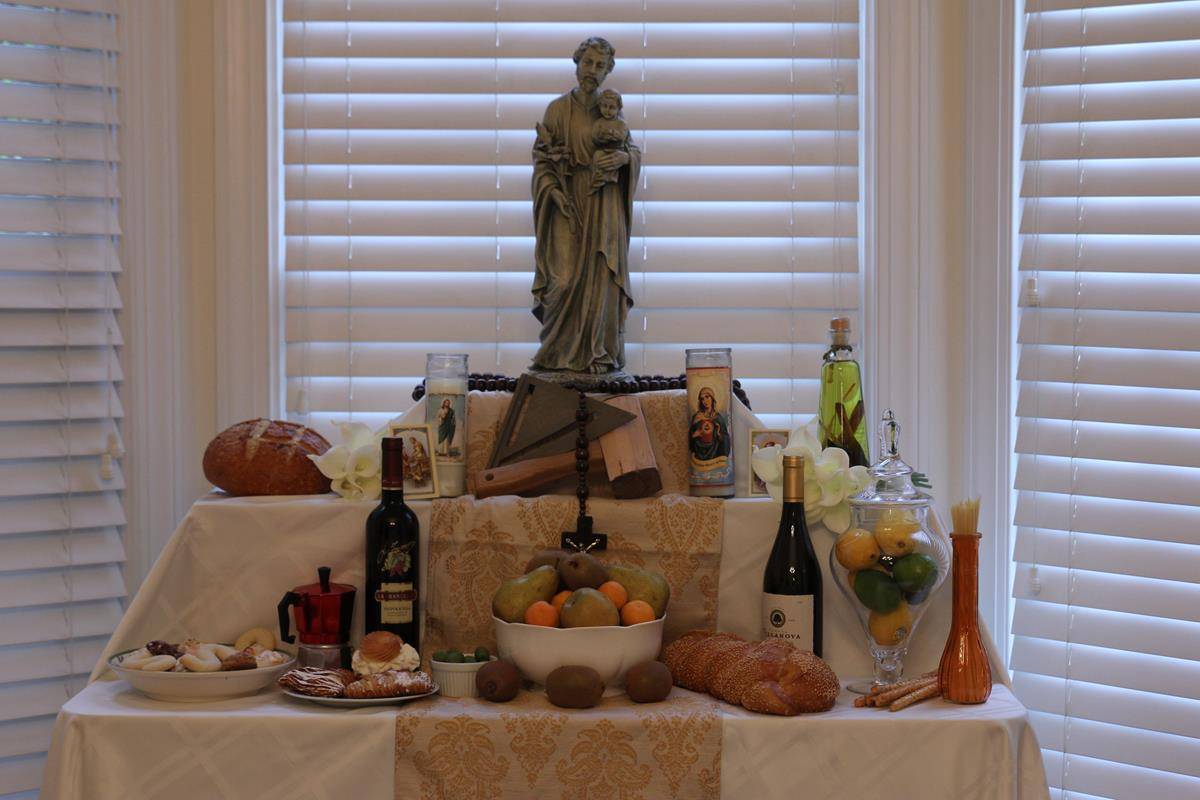
The Italian tradition of a St. Joseph Table is a popular devotion for the Feast of St. Joseph.
The “Tavola di San Giuseppe” (“St. Joseph’s Table” or “St. Joseph’s Altar”) originated in Sicily, which claims St. Joseph as its patron. It is practiced on March 19, the feast of St. Joseph. March 19 is also Father’s Day in Italy, which is fitting as St. Joseph was the foster father of Jesus.
This celebration featuring a makeshift shrine is a symbolic “thank you” and renewal of the Sicilian people’s devotion to St. Joseph.
It is a shared or communal celebration, in which the riches of food are given as alms to the poor and no one can be turned away. It has three aspects: veneration, special recognition of St. Joseph during Mass and at the “table”; the table, both a kind of “altar of reverence” and a communal celebration; and the poor, with the intention that the gathered food will help people in need.
Here’s how to set up your own St. Joseph Table at home or at your parish:

STEP 1: Choose a date and invite guests. If March 19 is not possible, celebrating a day or two before or afterwards is OK. It is ideal to host the celebration after Mass. Invite guests, especially children to dress up and play the parts of the Holy Family, the Apostles and angels. Guests should bring decorations or food items for the table.
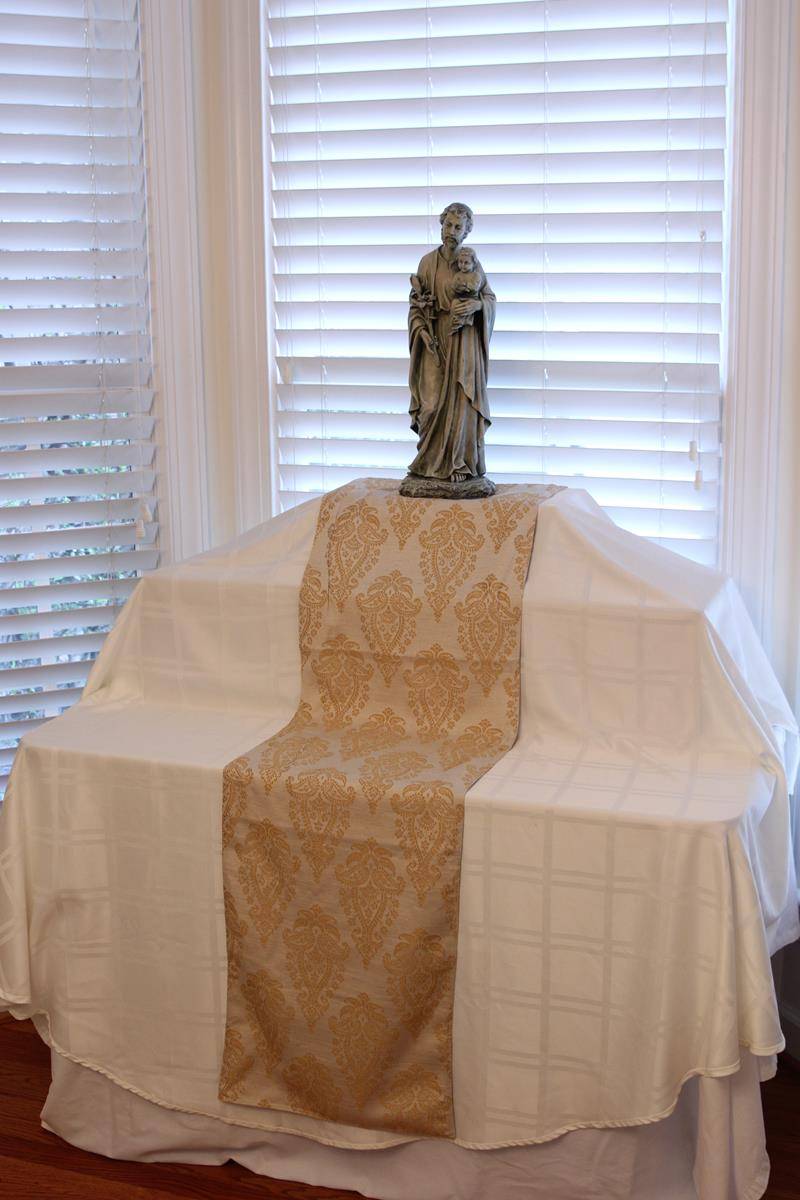
STEP 2: Set up the table. Place a table in a prominent location of your home or church. On the table, arrange at least two display tiers using durable boxes or small shelves. (The three tiers represent the Holy Trinity, and the ascent from earth to heaven.) Cover the table and tiers with a white tablecloth.
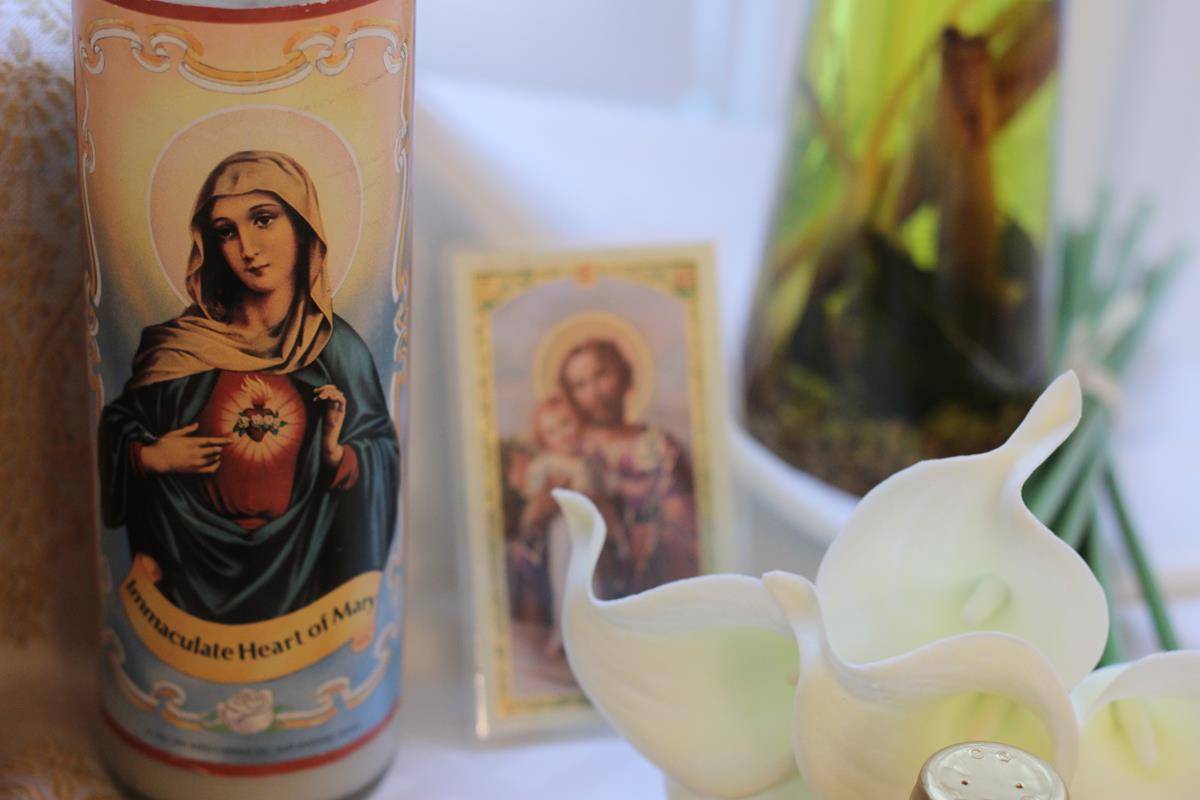
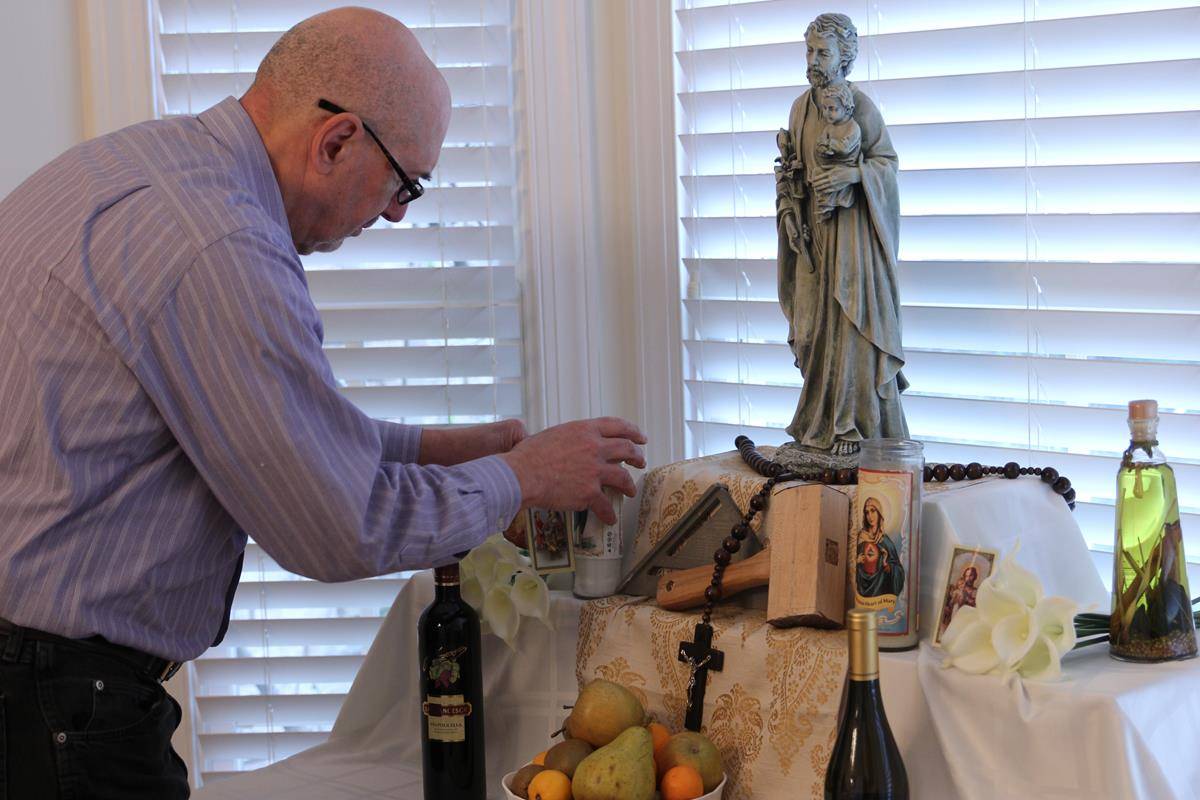 STEP 3: Decorate the table. Place a statue of St. Joseph on the top tier. On the other tiers, display flowers (white lilies, in particular), candles, statues, rosaries and holy cards. The setup should be solemn and festive – use your imagination! Vigil lights of green, brown and yellow (representing St. Joseph’s clothing) can be placed all around, and the table can be surrounded by palms reminiscent of the Holy Land.
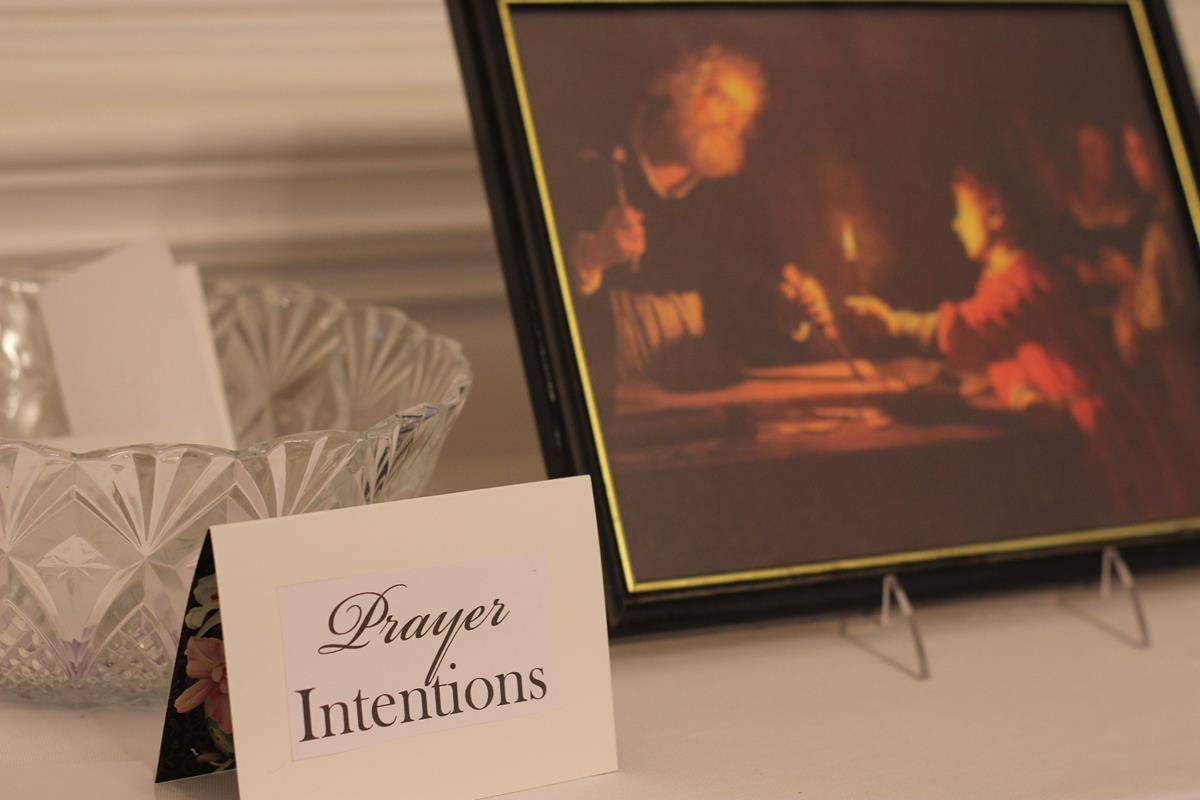
STEP 4: Set out a basket to collect prayer intentions and alms for the poor. You might collect canned goods for a food pantry or have a cash donation basket.
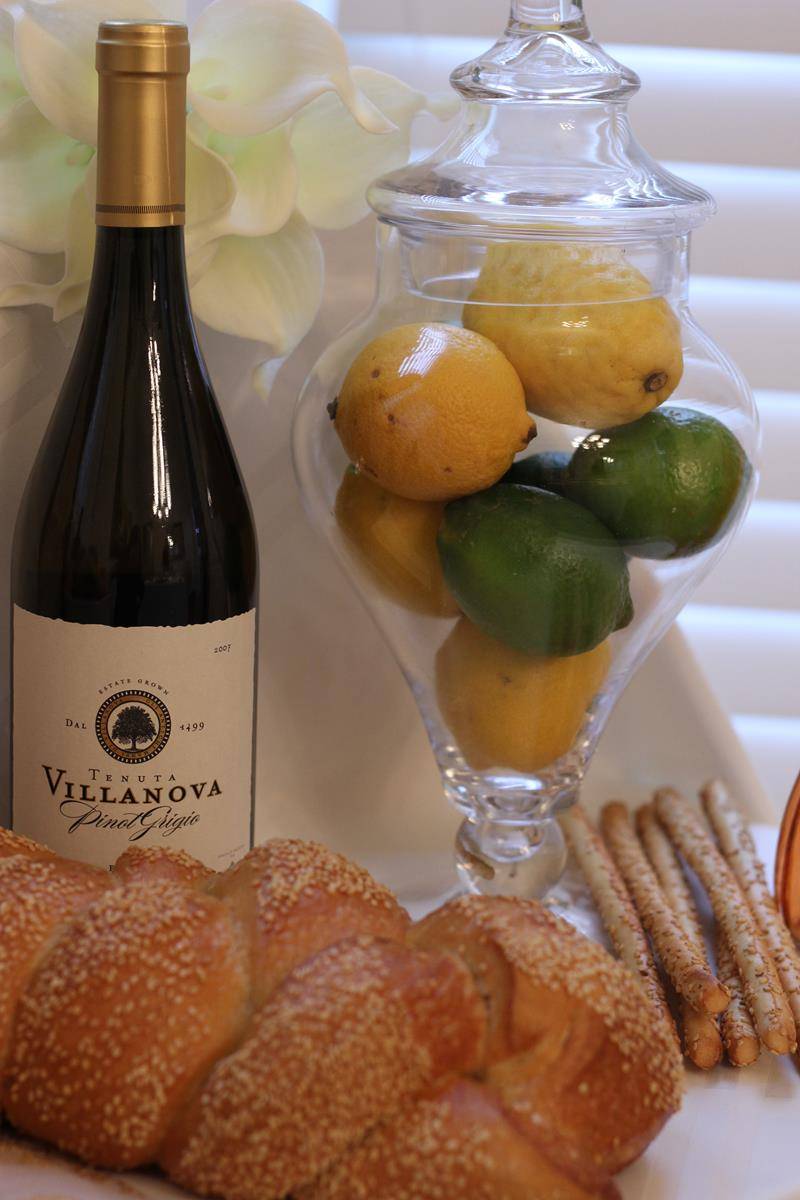
STEP 5: Prepare the menu. One traditional main dish in Sicily is “Carpenter’s Pasta” – pasta made with bread crumbs sautéed in butter to resemble sawdust – but you can include fish, soups or other pasta. Cheese isn’t used, symbolic of the food shortage experienced in the origin legend of the tradition. Sesame-coated artisan breads in symbolic shapes are a key centerpiece of the table and the menu. Don’t forget to include dessert: cakes, biscotti and cookies embellished with almonds are common. For menu ideas, go to www.yearofstjoseph.org.
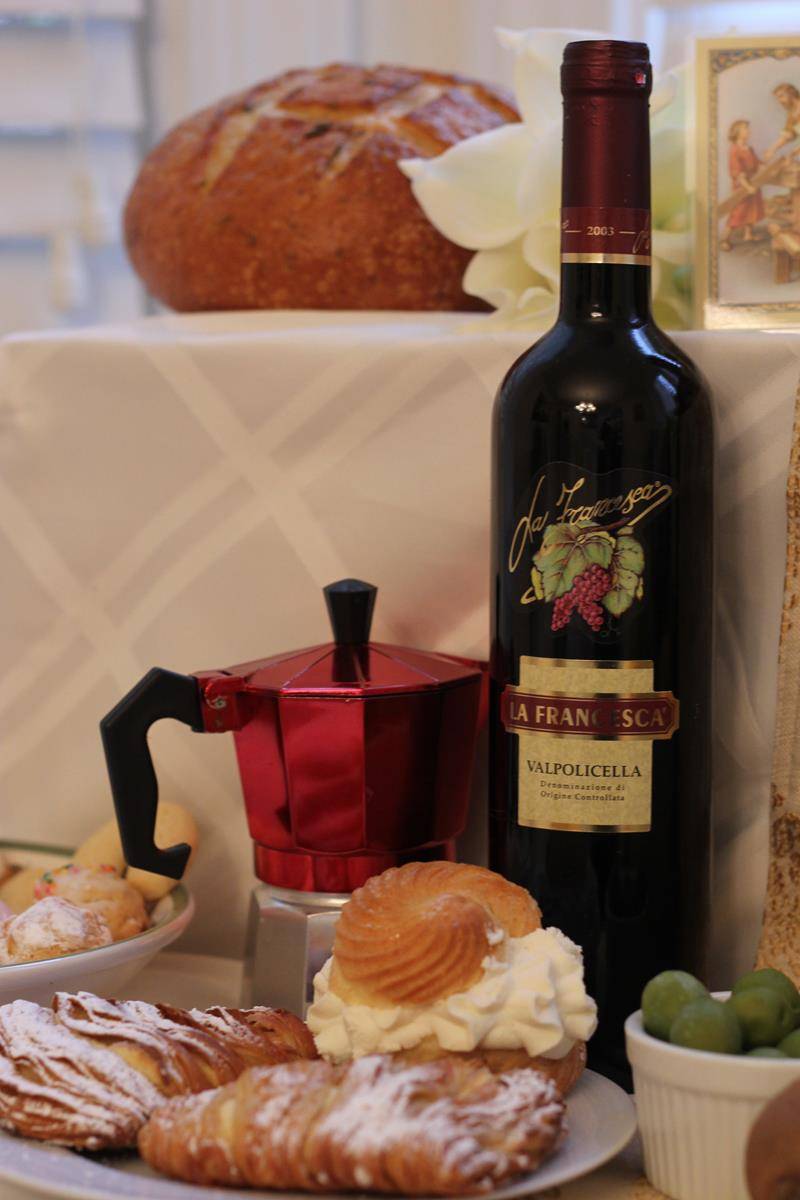
STEP 6: Gather and place specific foods on the table. Special breads, fruits, vegetables, baked goods, pasta, wine and olives are all traditional items found on a St. Joseph’s Table. But as it is Lent, omit any meats and cheeses. Arriving guests should place their items on or around the table.
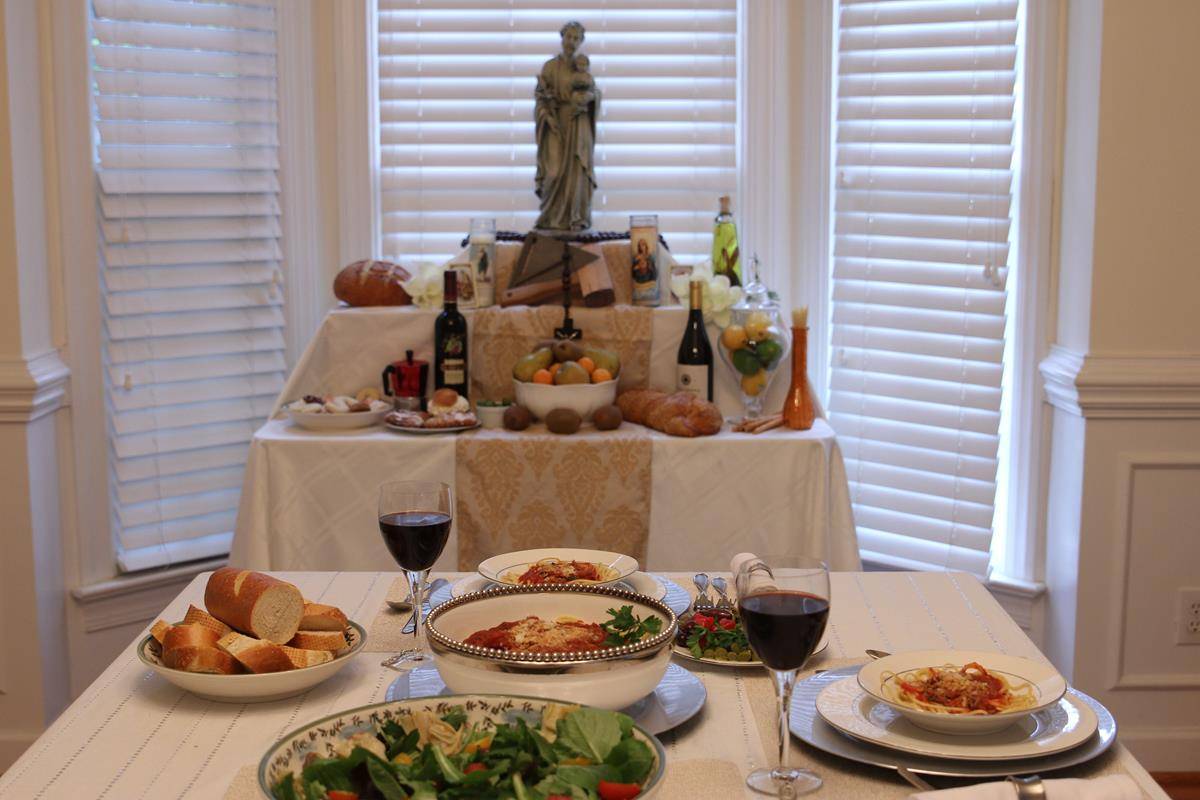
STEP 7: Bless the St. Joseph Table. Before or at the start of your celebration, invite a priest or deacon to bless your table, or pray together as a family.
STEP 8: Eat. The three children representing the Holy Family eat first, and they sit at a small table reserved just for them. Food is served buffet style.
STEP 9: Pray. After the meal, pray together as a group, seeking St. Joseph’s intercession. Pray the Litany to St. Joseph or use the diocese’s St. Joseph Prayer Book for other ideas. To end the celebration, offer guests a small gift such as a St. Joseph holy card. When possible, deliver the items collected for the poor to conclude the devotion.
— CatholicNewsHerald.. www.yearofstjoseph.org and Tom Sperrazzo contributed.
Learn more
For detailed information about the tradition and the setting of the St. Joseph’s Table, go online to the Year of St. Joseph website at www.yearofstjoseph.org/devotions/st-joseph-table.