


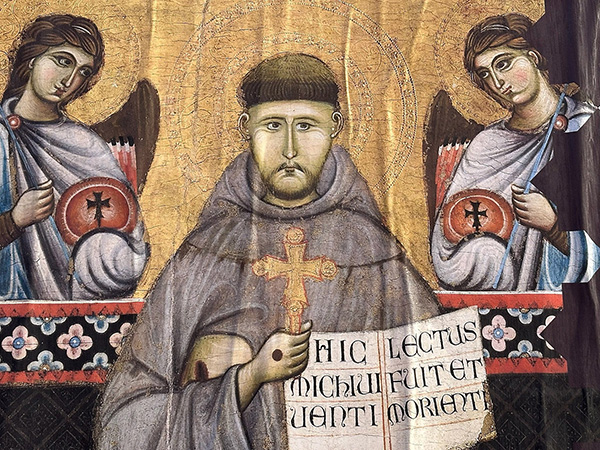
 St. Francis of Assisi’s father, Pietro di Bernardone dei Moriconi, was a gregarious and generous man, a very ambitious and successful businessman. He was part of the “new money” of the high Middle Ages known as the merchant class.
Born into the lower classes of society, he was determined to increase his family’s social status. He was domineering and driven but not abusive or wicked. He loved beautiful things like the fine cloth – purchased during frequent trips to France – which he would sell in his shop.
Giovanni was the firstborn of his children and also the first son, a privileged and favored position. He was born and baptized during one of his father’s absences. Pietro’s love for all things French caused him to refer to his newborn son as “Francesco.”
The father of St. Francis of Assisi was a “good man” characteristic of his era but driven by worldly ambition. He wanted to break the glass ceiling of his time and become a lord or “majore,” The only way for Pietro to achieve his ambition was for him or one of his sons to be victorious in battle.
The heart of a son
Francesco was the heir to the family business and fortune, and he willingly united himself with his father’s ambition.
When Assisi became engaged in a battle with the neighboring town of Perugia, Pietro sent Francesco off to war to win the longed-for family status.
After a year in battle, Francesco fell prisoner and wound up in a medieval prison cell for almost a year. It was during his confinement that he had a mystical dream that would be the start of his conversion.
Francesco was ransomed by his father and returned home a changed man. His health slowly returned, but he had completely lost interest in business and social ambitions. A growing divide with his father escalated, culminating in a public confrontation in front of the bishop of Assisi in which his father publicly disowned him.
The heart of a saint
Francesco approached life then as a penitent. Having been shown mercy by his heavenly Father, he realized that the Most High God was love poured out. Unlike his earthly father’s schemes to increase his status, God “emptied himself, taking the form of a slave, coming in human likeness; and found human in appearance, he humbled himself, becoming obedient to death, even death on a cross” (Phil 2:7-8).
Francesco’s mouth would water when he pronounced the holy name of Jesus, and his hunger would only subside in the reception of holy Communion, which became the center of his life. He was offered ordination as a priest, for which he felt unworthy. It is widely acknowledged that he accepted ordination as a deacon.
Francesco cherished this servant role at the altar and all things connected to it: the obligation to pray the Divine Office, the commitment to clerical continence, obedience to the bishop.
In every aspect of his life, Francesco sought after the “Spirit of the Lord and his holy operation,” which for Francesco meant the interior and exterior living of poverty modeled on the Most High, who once made himself poor in the child at Bethlehem and eternally poor and ever present to humanity in the Most Holy Sacrament of the Altar.
— Father Joseph Tuscan, OSV News
More online
At www.youtube.com/@dioceseofcharlotte: Watch Father Tito Serrano, OFM, as he explores what St. Francis had to say about nature, caring for the poor and more
What is ‘Transitus’?
Each year on Oct. 3, the followers of St. Francis of Assisi (1181-1226) mark the globally popular saint’s journey from life to death, his “Transitus” as it is known in Latin, through special community commemorations.
But what meaning does the Transitus hold – especially on this 800th anniversary of St. Francis’ death, and during the Jubilee Year of St. Francis proclaimed by Pope Leo – if you aren’t a Franciscan?
“I think the answer is self-evident. We are all going to die,” said Father Joseph Mary Elder, director of vocations and communications for the Capuchin Franciscans of the Province of St. Conrad in Denver.
“The Transitus is the celebration of the passing of St. Francis of Assisi from earthly life to heavenly glory,” he explained. “It is not so much the passing of St. Francis – everyone dies after all – but the manner in which St. Francis of Assisi died. St. Francis embraced death in much the same way he had learned to live his life: with a radical and total fearlessness.”
While Transitus traditions might appear slightly puzzling to non-Franciscans, Father Greg Friedman, an author, journalist and Franciscan friar in the Province of Our Lady of Guadalupe, offered a helpful context.
“If somebody said to me, ‘Why do you guys do this? Why do you celebrate the death of St. Francis every year?’ I would say, ‘Well, how do you remember the people in your family? How do you remember your grandparents; your great-grandparents?’” he asked. “You tell the story.”
— OSV News