


Who will tell our story?
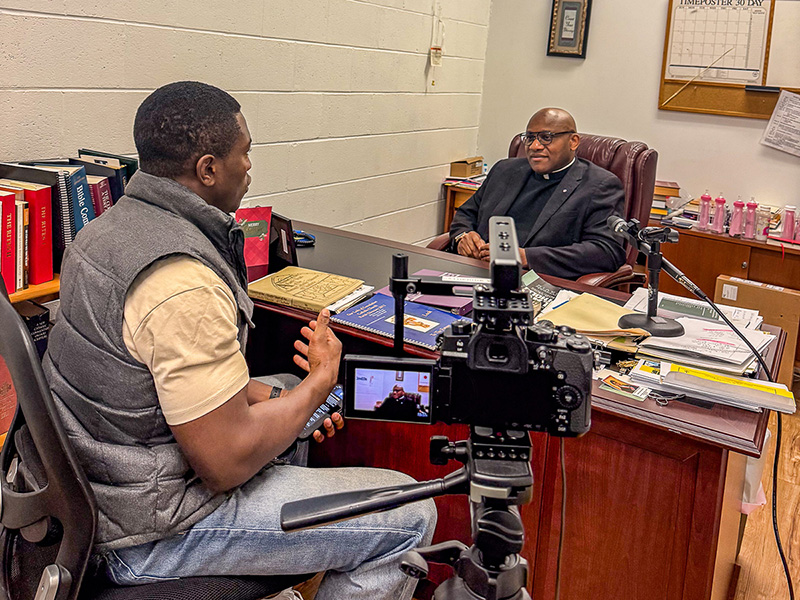 Capturing stories of the people in the pews around you and of clergy such as Father Marcel Amadi, pastor of Our Lady of Consolation Parish in Charlotte, can preserve Black Catholic history. Youth at Our Lady of Consolation are preserving the stories and placing them on the parish’s social media accounts. (Provided and Leah Holloway | Catholic News Herald) CHARLOTTE — Imagine sitting at Mass beside a parishioner you have known for years. You know their name, you exchange greetings, maybe you have served on a committee together. But how much do you really know about them?
Perhaps they remember attending Mass when they could not sit wherever they wanted or their parents attended a segregated Catholic school.
The person sitting beside you may be carrying a chapter of Black Catholic history that they were never asked about.
More than written words
Each November, Black Catholic History Month invites us to celebrate the remarkable contributions of Black Catholics to the Church. We honor familiar names such as Venerable Augustus Tolton, Venerable Mother Mary Lange, Venerable Henriette Delille and Servant of God Sister Thea Bowman, whose lives continue to inspire. But Black Catholic history extends beyond the individuals whose stories have been documented in books, museums and archives.
Black Catholic history also lives in our families, parishes, ministries and communities; in faded photographs, old church bulletins, family Bibles and the experiences of ordinary people whose faith, perseverance and service helped shape the Black Catholic communities we know today.
These stories may never make national headlines, but they are no less important to understanding our shared history.
History sitting beside us
Consider the wealth of history that may be present in our own pews. There are parishioners who remember a time when racial barriers shaped their experiences within the Church, those who witnessed the arrival of the first Black priest at their parish, and choir members who remember how Black sacred music became a more visible part of worship. Others remember the establishment of Black Catholic ministries, pilgrimages, cultural celebrations and efforts to create faith communities where their history, culture and traditions are reflected and celebrated.
These are not simply personal memories. They are firsthand accounts of Black Catholic life, offering perspectives that historical documents cannot capture. Yet, how often do we take the time to ask about these experiences? How many stories remain untold because we assume there will be another opportunity to hear them or that someone else will take the time to preserve them?
Every generation carries memories that the next generation cannot recreate. Once those voices are gone, the opportunity to hear their stories firsthand disappears with them.
Why tell the story?
February 2026 marked 100 years of commemorating Black history in America. In recognition of the centennial, Bishop Daniel E. Garcia and Bishop Roy E. Campbell Jr. encouraged Catholics to become “faithful stewards of memory” and “courageous witnesses to truth.” Their message reminds us that preserving history is not simply honoring accomplishments. It also means acknowledging difficult experiences and ensuring that the lessons of the past are not forgotten.
Dr. Ansel Augustine makes a similar point in his USCCB reflection, “Telling the Whole Story.” He emphasizes that Black Catholic history is essential to understanding the fullness of the universal Church. When these stories are absent, an important part of the Church’s identity and lived experience is missing.
This is why the stories of everyday Catholics matter. We all need to know about the people who worshiped, served, persevered and helped build the Church before us. Their stories help us understand how we arrived here and to see Black Catholic faith and culture as an integral part of the Church’s living tradition.
As we learn these stories, we also become responsible for carrying them forward. Each of us has a place in that history: those who remember it, those who are discovering it and those who will one day tell the stories of our time.
Our history not only tells us where we have been; it also helps all of us understand where we belong.
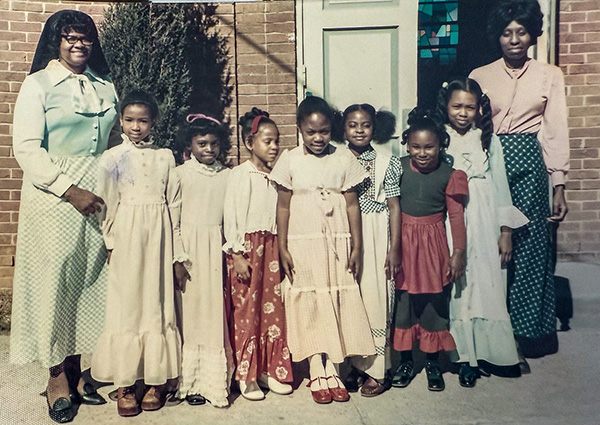 This photo of the former Our Lady of Consolation School – which closed in 1988 – was provided by parishioner Mary McDonald, a former educator there. Preserving these photos and moments in social media posts, videos and other accessible ways helps share stories from the past that might otherwise be lost.
How we tell the story
For generations, families, parishes and dioceses have preserved history through photographs, written records, newspaper articles, archives and oral traditions. These remain invaluable resources. Today, the phone in our hands is another powerful tool for preserving history. It can turn a memory into a story that lives beyond that moment.
Platforms such as Facebook, Instagram and YouTube allow us to share those stories in our own voices and introduce them to people far beyond our communities.
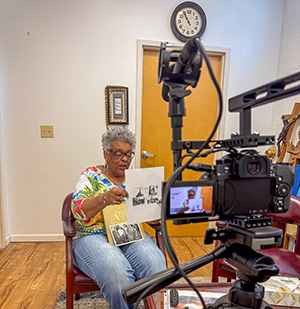
Imagine what we could preserve if we looked at the conversations and memories around us. A story about growing up Black and Catholic could become a recorded conversation. An old photograph could provide an opportunity to identify the people pictured and tell what was happening at the time. The story behind a beloved song, ministry or tradition could reveal how a parish community became what it is today. These are the kinds of moments that can make us stop and say, “I never knew that.”
A social media page is more than a place for announcements and event photographs. A two-minute video featuring a longtime parishioner, a post pairing an old photograph with the story behind it, or a series highlighting moments from a parish’s history can make those memories accessible to a new audience. Stories can now travel much farther.
We should view these familiar platforms not only as places to share what is happening now, but as tools for documenting the history unfolding around us.
Who will tell our story?
Some of the most valuable chapters of Black Catholic history may never be formally recorded. They are found in the lives of people who have helped shape our communities. Their stories deserve to be heard, remembered and preserved.
As we celebrate Black Catholic History Month, perhaps the most meaningful thing we can do is begin a conversation.
Invite a longtime parishioner to share a memory or experience. Record a family story. Identify the people in an old photograph and share the story behind it. Use the tools available to capture a piece of Black Catholic history and ensure it does not disappear.
One day, future generations will want to know what Black Catholic life was like in our time, how we worshiped, how we served, how we faced challenges and how we carried our faith forward.
Who will tell our story? We will.
Continue exploring Black Catholic history, education, faith and life by following the Diocese of Charlotte’s African American Affairs Ministry and Our Lady of Consolation Church on Instagram.
— Rosheene L. Adams, African American Affairs Ministry, Diocese of Charlotte