


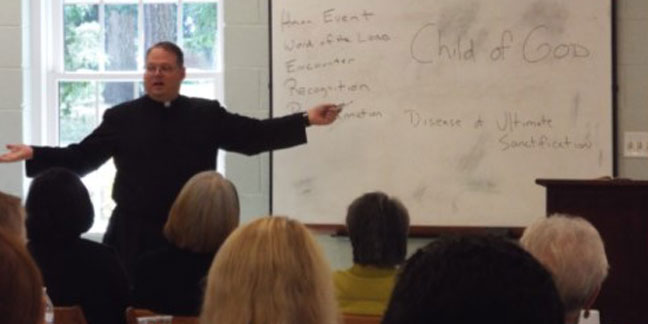
 MONROE — Our Lady of Lourdes Church has added a new approach to adult education. “You can call it a mini-retreat. You can call it adult ed. You can call it Catechism classes. You can call it whatever you want,” but the Saturday - Days of Reflection are becoming a hit at the growing parish in Monroe.
“The issue often encountered with the ‘usual’ Tuesday night mini-series (available at most churches),” says Father Benjamin Roberts, pastor, “is the first session has a decent turnout. The second, maybe a couple of people do not make it. By the end of the sixth meeting, the crowd dissipates and there is about a third of the people left.
“A six-hour Saturday reflection is a more practical approach for both parishioners and staff. Instead of taking six separate days over the course six weeks, we can get everything done on one Saturday.”
“The idea for the one day reflections occurred to me when we had Virginia Lieto (a public speaker who attends St. James Church) come give her ‘Living a Virtuous Life’ Retreat. We had a great response. The model of the one-day event worked well. I did the first of our days of reflection a few months after,” Father Roberts explains.
Each day of reflection is designed to make the most of people’s time, and each program is carefully planned. To minimize costs, Father Roberts teaches most of the classes, enabling the parish’s secretary Becky Wright to afford to provide participants breakfast, lunch and dessert. This way, the parish does not have to take up a collection to underwrite the programs, Wright notes.
Wright said she enjoys serving bagels and chicken salad croissants to fellow parishioners, but she finds the lessons just as filling. “Father Benjamin gets excited to teach because he wants to challenge us to expand our holiness. Ultimately, Father’s goal is to get us closer to God. These classes push us to take that leap of faith. It is awesome to know that God is right there with us.”
Reflection attendee Christine Aguirre says, “This is the third reflection I have attended. They are fun and very informative. I enjoy learning all about Catholicism because there are so many things I still do not know, even though I have been Catholic all my life. I work full time. When I get off, all I want to do is change into something comfortable and stay home. One Saturday, every quarter, is perfect. I wouldn’t be able to attend otherwise.”
Having a pastor as the teacher has other benefits as well. Explains Aguirre, “I like getting to know Father Benjamin. He gives such clarification on the topics and he is very personable. The last reflection day was about Mass. I had many questions but never had the proper occasion to ask. This is a very intimate setting. I feel comfortable here.”
The most recent class, “Recognizing God’s Presence,” ran from 8:30 a.m. to 2:30 p.m. Aug. 26 with a break at 10, and lunch at noon. Father Roberts filled the day in the roles of teacher, storyteller, comedian and philosopher. The crowd giggled when he called Moses “the first basket case.” Interest grew when he revealed Catholic tidbits such as “St. Peter is buried under the altar of St. Peter’s Basilica. Adorning his burial is an upside-down cross symbolizing his crucifixion. His bones indicate that his feet were cut off.”
The overall message of the day focused on seeking God’s presence in one’s life. Father Roberts demonstrated the five-step process for recognizing God’s presence, describing the personal journey of his maternal grandmother’s death.
At the end of the program, he asked the crowd, “Does this help you? Did you learn anything from this process? Could you use this in your own life?”
Participants nodded with and responded positively. Then a hand quietly rose, and the person said, “This helped me see that God really does love me. All this time, all these hard trials, all along, it was actually part of some plan.”
— Lisa Geraci, correspondent